Best tools for solopreneurs (2026): the complete one-person business stack
The best tools for solopreneurs, organised by need — what every one-person business and freelancer actually needs to get paid, build, grow and run, with an EU angle on VAT, banking and data residency.

Solo operator · one-person venture studio in Europe (SEO · affiliate · micro-SaaS) · 12 June 2026 · updated 12 June 2026 · 11 min read

Search “best tools for solopreneurs” and you get a list of fifty apps and a vague promise that you need most of them. You do not. A one-person business runs on a handful of jobs, and each job needs exactly one good tool — the rest is noise that costs money and attention you cannot spare as a team of one.
This is the master hub. Instead of re-reviewing every tool, it organises the whole stack by the job it does, names one top pick per job, and links down to our full roundup for each category so you can go deep where it matters. The bias throughout is European: a solo in the EU has to think about VAT, euro banking and data residency in ways US lists quietly skip.
How to read this. Each section explains the need, gives one default pick, and points to the full comparison. If you are starting from zero, do the jobs roughly in order — get-paid first, then invoicing, then build, then audience. You do not need all six on day one. Start lean, add a layer only when a real limit bites.
At a glance
| The job | Top pick | Full roundup |
|---|---|---|
| Get paid & banking | Wise | Business bank accounts · Payment processors |
| Invoicing & EU VAT | Xolo | Invoicing & accounting |
| Build & launch | Systeme.io | All-in-one platforms · Landing builders · Hosting |
| Audience & email | Kit | Email marketing |
| Run & organise | Notion | Project management |
| Work smarter with AI | Claude | AI tools · AI creator tools |
| Sell knowledge | — | Course platforms |
1. Get paid & banking
Before anything else, you need somewhere for money to land. For a solo dealing with clients or customers across borders, the default current account is the wrong tool — currency conversion quietly eats 2–4% per payment. What you want is a multi-currency account with a real euro IBAN, low transparent fees, and the option to hold and convert at the mid-market rate. Pair that account with a payment processor for selling digital products online.
Wise
Wise gives a solopreneur a euro IBAN plus local account details in other currencies, so clients pay you as if you were local and you convert at the mid-market rate when you choose. There is no monthly fee — you pay a small, transparent cost per transaction — which makes it the natural first account before revenue justifies anything heavier.
It is not a full business bank (no lending, limited integrations versus a Revolut Business or a traditional account), but as the place money lands and waits, nothing beats it on cost clarity for a cross-border one-person business.
Go deeper: the full business bank accounts roundup compares Wise, Revolut Business and N26 for EU freelancers, and the payment processors roundup covers Stripe, Paddle and Lemon Squeezy for actually charging customers — including which ones act as merchant of record so you do not handle EU VAT yourself.
2. Invoicing & EU VAT
Getting paid is one job; staying compliant is another. The moment you invoice EU clients or sell digital products across borders, VAT stops being optional admin and becomes a recurring trap — OSS thresholds, reverse charge, country-by-country rates. The right tool either automates the invoice-and-VAT paperwork or removes it entirely by giving you a company and accounting layer that handles it for you.
Xolo
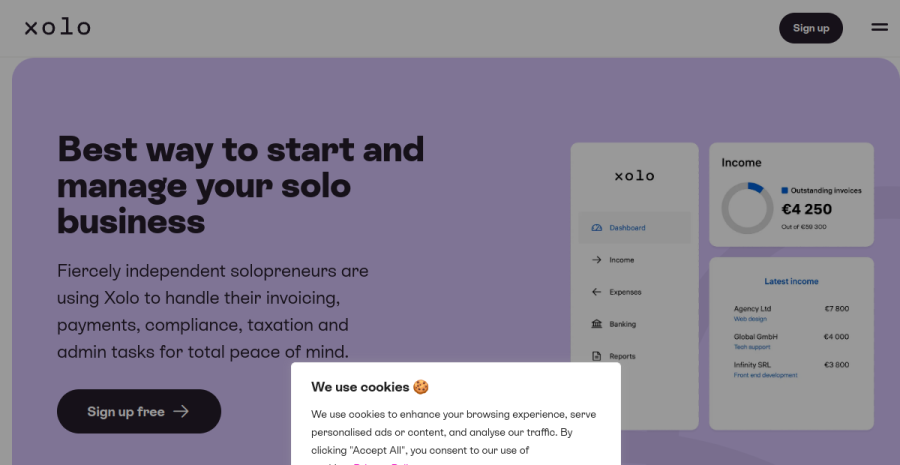
Xolo is built for exactly this problem: it gives EU solopreneurs (originally via Estonian e-Residency) a company, invoicing, expense tracking and VAT/accounting handled in one place, so the compliance you would otherwise pay an accountant for is bundled in. For a freelancer who wants to invoice cleanly across the EU without learning each country’s VAT rules, it removes the part of solo business that causes the most quiet anxiety.
It is more than a pure invoicing app — and priced accordingly — so if you only need to send the occasional invoice, a lighter freemium tool may be enough to start.
Go deeper: the invoicing & accounting roundup weighs Xolo against lighter, cheaper invoicing tools and pure VAT layers like Quaderno, so you can match the tool to whether you need full bookkeeping or just compliant invoices.
3. Build & launch
Now you need somewhere to put the offer: a landing page, a checkout, a place for people to say yes. This is where solos most often over-build — stitching a site builder to a checkout to an email tool over a wasted weekend. For most one-person product launches, a single all-in-one platform replaces that whole chain and gets you live in an afternoon.
Systeme.io
Systeme.io bundles landing pages, funnels, a checkout, email and a course area on a genuinely free plan (one funnel, one product, 2,000 contacts). For a solo launching a digital product, that means one login instead of four subscriptions and zero integration work — the single biggest time saver in the early build phase.
It is not the best at any individual job, but for getting from idea to a live, sellable page fastest, an all-in-one wins for a team of one. Move to dedicated tools later if a specific job outgrows it.
Go deeper: compare the all-in-ones in the all-in-one platforms roundup, look at lighter single-page tools in the landing page builders roundup, and if you are running your own site or app, the hosting roundup covers EU-friendly hosts like Hostinger — reviewed on its own in the full Hostinger review. Selling physical or digital products? The e-commerce platforms roundup (Shopify vs WooCommerce vs Etsy) decides it on who owns the customer and who owns the VAT.
4. Audience & email
Social reach is borrowed and search traffic is rented; an email list is the one asset a solo actually owns. It survives a pivot, a dead product or an algorithm change — which is why capturing emails should start the day you have anything worth sharing, not the day you launch. The tool matters less than starting, but it still matters.
Kit
Kit (formerly ConvertKit) is purpose-built for independent content businesses — tags and segments instead of spreadsheet columns, a visual automation builder, and a free tier that runs to 10,000 subscribers, so most solos never pay before they are making money.
Its one EU caveat is data residency: Kit runs on US servers. If an EU-hosted list is a hard requirement, the full roundup covers Brevo (Paris) and MailerLite (Vilnius) as EU-native alternatives.
Go deeper: the email marketing roundup compares Kit against Brevo, MailerLite and Systeme.io’s built-in email, with GDPR, EU data residency and free-tier ceilings broken down tool by tool. If the newsletter is the business, see the newsletter platforms roundup (Substack vs beehiiv vs Ghost); to capture the signups in the first place, the form builders roundup (Tally vs Typeform) covers lead capture with the GDPR angle.
5. Run & organise
With money, compliance, a page and a list in place, you need one calm place to actually run the business — notes, tasks, content calendar, client docs, the half-formed idea you will forget otherwise. As a solo you do not need a heavyweight project-management suite; you need one flexible workspace you will genuinely open every day.
Notion
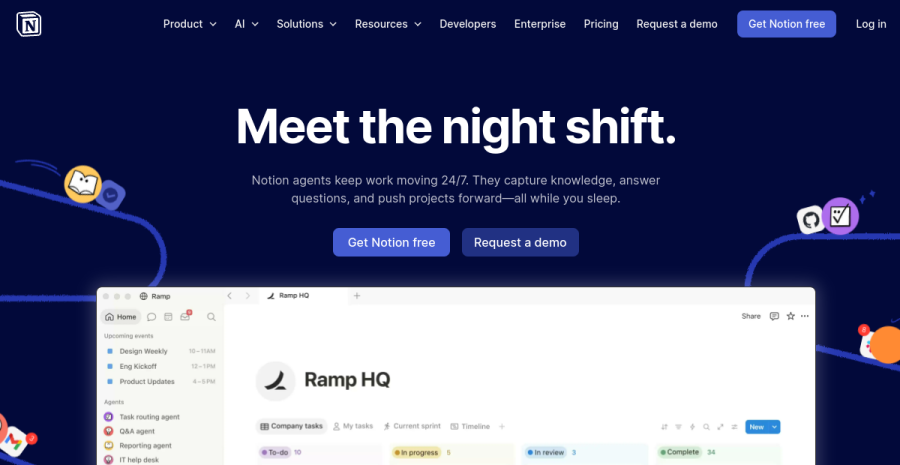
Notion bends to whatever a solo needs it to be — a task board one day, a content calendar the next, a CRM, a wiki, a second brain. The free personal plan is enough to run an entire one-person business, and because everything lives in one tool there is no context-switching tax between notes and tasks and docs.
Its flexibility is also its trap: it is easy to spend the time you saved building the perfect system instead of doing the work. Keep it simple and it is the best single workspace a solo can have.
Go deeper: the project management roundup weighs Notion against lighter, more opinionated tools (Todoist, Trello, ClickUp) for solos who would rather have structure handed to them than build it themselves.
6. Work smarter with AI
The newest layer of the stack, and the one with the highest leverage for a team of one. An AI assistant is the closest a solo gets to hiring — a researcher, editor, coder and brainstorming partner on demand. It does not replace any tool above; it makes you faster at using all of them.
Claude
Claude is a strong default AI assistant for a solopreneur: capable at long-form writing, editing, coding and reasoning through decisions, with a usable free tier and an affordable Pro plan. For a one-person business it functions as the cheap extra pair of hands you cannot otherwise afford — drafting copy, debugging a script, pressure-testing an idea at 11pm.
ChatGPT is an equally valid pick here; the right answer is usually whichever one you will actually open. Most solos settle on one and add specialised AI tools (image, video, voice) only for specific tasks.
Go deeper: the AI tools roundup covers general assistants and productivity AI, while the AI creator tools roundup goes into image, video and voice tools for content production. For the specific decisions: which assistant to pay for (ChatGPT vs Claude, plus Google Gemini if you live in Workspace), whether you need a dedicated AI writing tool, and — if your work runs on calls — an AI meeting notetaker.
7. Sell knowledge
If your business is teaching what you know — a course, a cohort, a structured program — you eventually outgrow a PDF and a checkout. A dedicated course platform handles hosting, drip-content, student progress and payments so you can focus on the material rather than the plumbing. This is an add-when-you-sell-knowledge layer, not a day-one essential.
Go deeper: the course platforms roundup compares the options — from lightweight tools like Payhip to full platforms like Teachable and Thinkific, plus Systeme.io’s built-in course area if you are already on it — so you do not over-buy before you have your first cohort.
The cheapest stack: start at ~€0
You do not need a budget to start. The leanest viable stack for a one-person business looks like this, and it costs essentially nothing until a real limit forces an upgrade:
| Job | Lean start | Monthly cost |
|---|---|---|
| Get paid | Wise (pay per transaction) | €0 base |
| Invoicing | Freemium invoicing tool | €0 to start |
| Build & launch | Systeme.io free | €0 |
| Kit free (to 10k subs) | €0 | |
| Run & organise | Notion free | €0 |
| AI assistant | Claude / ChatGPT free | €0 |
The honest first upgrade most solos pay for is the invoicing/VAT layer the moment real EU sales start, followed by email or build once a free-tier ceiling bites. Everything else can stay free far longer than you would expect. The goal is not to assemble the perfect stack — it is to spend nothing until revenue tells you where to invest.
EU footnote: why a European solo’s stack differs
A US “best tools” list optimises for a US business — if that’s actually you, see the US lean stack. Three places change for an EU solopreneur, and they are exactly the places where money and data live:
- VAT is not optional admin. Selling digital products across the EU triggers OSS/VAT-MOSS rules and country-by-country rates. Choose an invoicing tool that automates EU VAT (or a payment processor that acts as merchant of record and handles it for you) rather than a US tool that ignores it entirely. See the invoicing and payment processors roundups.
- Banking is euro-first. A euro IBAN and multi-currency account (Wise, Revolut Business) matches how EU clients pay and avoids quiet conversion losses on every invoice — see the business bank accounts roundup.
- Data residency simplifies GDPR. For an EU audience, EU-hosted email and analytics make compliance documentation easier — the email roundup flags which tools store data in the EU. For build tools, AI and project management, the global picks are perfectly fine.
The rule of thumb: pick EU-aware tools for money and data, and the best global tool for everything else.
Start here
If you are building your first one-person stack, do not buy anything yet. Open a Wise account so money has somewhere to land, start free on Systeme.io so you have a page to point people at, and capture emails with Kit from day one. Add invoicing and VAT the moment real EU sales begin, and a course platform only when you sell knowledge. Lean stack first; complexity only when revenue earns it.
Start free on Systeme.ioEach section above links to a full roundup with worked examples, EU-specific detail and side-by-side comparisons. Start with the job that is blocking you today, and come back for the next layer when you need it.
Frequently asked questions
What tools does a solopreneur actually need?
What is the cheapest solopreneur tool stack?
Best all-in-one tool for a one-person business?
Do EU solopreneurs need different tools?
Keep reading
Best tools for solopreneurs in the US (2026): the lean stack
The best tools for solopreneurs in the US, organised by need — the global, lean stack a one-person business and freelancers actually run on to get paid, build, grow and run.
Make vs Zapier for solopreneurs (2026): which automation tool to pick
Make vs Zapier for a one-person business — the polished market leader with the widest app library versus the visual scenario builder that goes further for less at volume. The honest fit-comparison, who each suits, the cost-at-scale angle, and where n8n fits. From a team of one.
Pipedrive vs HubSpot for solopreneurs (2026): which CRM fits a team of one
Pipedrive vs HubSpot for a one-person business — a lean, visual sales-pipeline CRM versus a broad platform with a genuinely capable free tier. The honest fit-comparison for a solo, who each suits, and the over-tooling trap to avoid. From a team of one.
Everything here is free. If something saved you time, you can support the author — no product, no signup.