Best invoicing & accounting tools for EU solopreneurs (2026)
VAT, OSS and e-Residency make European invoicing its own beast. The best invoicing and accounting software for EU solopreneurs, freelancers and the self-employed — tested with a real solo workflow.

Solo operator · one-person venture studio in Europe (SEO · affiliate · micro-SaaS) · 25 May 2026 · updated 9 June 2026 · 5 min read

Invoicing as a European solo is not the same problem as invoicing in the US. The moment you sell across a border you hit VAT, reverse-charge and — for digital goods — OSS reporting. The tools below are ranked by how little of that they make you think about.
How I evaluated these. I run a one-person EU business myself, so the test isn’t a feature checklist — it’s a workflow. For each tool I asked the four questions that actually decide a solo’s quarter-end: Does it apply the correct cross-border VAT rate automatically? Does it keep the location evidence digital sales legally require? Does it produce an OSS-ready report? And can I run it without hiring anyone? Prices below are the public 2026 figures — always confirm on the vendor’s page before you commit, because they move.
The shortlist at a glance
| Tool | Best for | Does VAT/OSS rates | Real accountant | Indicative price |
|---|---|---|---|---|
| Xolo | Service solos who want it done for them | ✅ (handled for you) | ✅ included | from ~€59/mo |
| Wise | The money layer under everything | ➖ (not its job) | ❌ | free acct, pay-per-FX |
| Quaderno | Digital-product sellers on Stripe/Paddle | ✅ (auto at checkout) | ❌ | from ~€49/mo |
Three tools, three different jobs — most solos end up using two of them together, not picking one.
1. Xolo — the least-headache option
Xolo
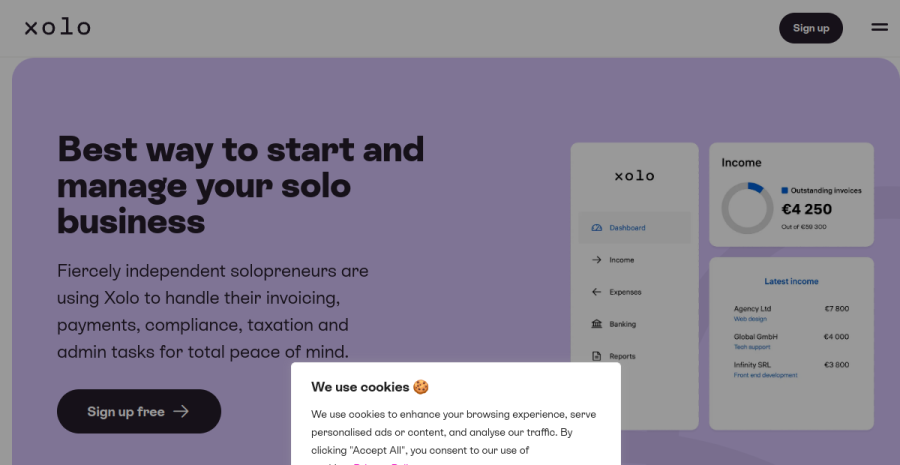
If you want invoicing, bookkeeping and an actual accountant handling your Estonian/EU filings, this is the closest thing to “done for you”. Built around e-Residency, so it fits remote founders especially well.
Where it shines. A freelance designer in Berlin billing clients in three countries doesn’t want to learn reverse-charge rules — Xolo’s flow applies them, and a human checks the books. You get a legal address, monthly bookkeeping and the OÜ admin in one subscription instead of a bookkeeper on retainer.
Pros: one login for company + invoicing + accountant; built for e-Residency; removes the “do I owe VAT here?” question. Cons: monthly cost is higher than self-serve tools; it’s oriented around an Estonian OÜ, so it fits that structure best.
Best for: service solopreneurs (consulting, design, dev) who would rather pay to never think about EU filings.
2. Wise — the money layer
Wise
Not accounting, but the multi-currency business account most EU solos end up running. Get paid in several currencies without the bank eating the spread — local receiving details in EUR, USD and GBP mean a US client pays you like a local and you convert at the real mid-market rate.
Concrete example. Invoice a US client $2,000. Through a typical high-street bank’s 2–4% FX spread you’d quietly lose $40–80 on that single invoice; held in Wise and converted at mid-market, most of that stays yours. Across a year of cross-border invoices that gap is a meaningful slice of a solo’s income.
Pros: real mid-market FX; free to open; the account other tools plug into. Cons: it is not accounting — it won’t do your VAT, OSS or bookkeeping, and treating it as your books is a quarter-end trap.
Best for: literally any solo invoicing across currencies. It sits under whichever accounting tool you pick. More on the mechanics in getting paid across borders.
3. Quaderno — VAT/OSS on autopilot
Quaderno

Selling digital products through Stripe or Paddle? Quaderno automates the EU VAT and OSS side so you’re not reconciling tax rates by hand at quarter’s end. It watches each sale, applies the buyer’s local rate, collects the location evidence the rules demand, and spits out an OSS-ready report.
Concrete example. You sell a €39 course. A buyer in France should be charged 20% VAT, a buyer in Germany 19%, a buyer in Hungary 27% — and you must keep two non-contradictory pieces of evidence of where each buyer was. Doing that by hand across a few hundred sales is a lost weekend; Quaderno does it at checkout.
Pros: correct rate per country automatically; OSS-ready reporting; integrates with the checkouts solos actually use. Cons: it’s a VAT/reporting layer, not a bookkeeper or an accountant — you still file (or hand off) the return.
Best for: digital-product and SaaS solos doing enough volume that manual rate-handling is a real risk.
How to choose
| If you are… | Start with | Why |
|---|---|---|
| A service solo who hates admin | Xolo | One login does company, books and accountant |
| Selling digital products at scale | Wise + Quaderno | Auto VAT rates + clean money layer, lower cost |
| Getting paid in multiple currencies | Wise (always) | Stops the FX spread regardless of your stack |
| Just starting, under €10k cross-border | Free invoice + Wise | Charge home VAT, keep records, upgrade later |
The right answer is the one you’ll actually keep using at quarter-end.
A worked example: which stack for which solo
- Lena, freelance UX designer, ~€60k/yr, EU clients only. Service income, hates admin, no products. → Xolo. The accountant earns its fee the first time reverse-charge comes up.
- Marco, sells a €29/mo SaaS, EU + US buyers. High transaction count, digital goods. → Wise + Quaderno. Quaderno handles per-country VAT; Wise handles the dollars.
- Aisha, just launched a €19 ebook, pre-€10k. Tiny, occasional sales. → Free invoice generator + Wise, charge home-country VAT, revisit once she nears the threshold.
Before you pick: understand what you’re filing
The tool only helps if you know what it’s automating. New to invoicing itself? Start with how to invoice clients as a freelancer in the EU (legal fields, VAT cases, getting paid on time) and the common invoicing mistakes that delay payment. Then two explainers worth reading: the €10,000 threshold and the One Stop Shop, and — if you’re choosing where to base the business — whether Estonian e-Residency is worth it in 2026. The whole five-tool setup I personally run sits in my one-person stack.
Frequently asked questions
Do I legally need invoicing software as an EU solopreneur?
What is the cheapest way to invoice and stay VAT-compliant?
Xolo vs Wise + Quaderno — which should I choose?
Does invoicing software handle EU VAT OSS filing for me?
Keep reading
France e-invoicing 2026: what a micro-entrepreneur must do by 1 September 2026 (and by 2027)
From 1 September 2026 every French business, micro-entrepreneurs included, must be able to receive electronic invoices through an accredited platform; issuing becomes mandatory for small businesses on 1 September 2027. What the reform means for a one-person business, what a plateforme agréée is, and the two decisions to make now.
Germany e-invoicing 2025–2028: what freelancers and Kleinunternehmer must do now
Since 1 January 2025 every German business, freelancers included, must be able to receive structured e-invoices (XRechnung or ZUGFeRD). Issuing becomes mandatory in 2027 for larger businesses and in 2028 for everyone, with Kleinunternehmer exempt from issuing but not from receiving. What that means for a Freiberufler, in plain terms.
How to validate an EU VAT number before invoicing (VIES), and what to keep as proof
Before you issue a reverse-charge invoice to a business in another EU country, you must check that the client's VAT number is valid. How VIES works, what to do when it says invalid, the consultation number to keep, the new EX numbers under the SME scheme, and how to automate the check.
Everything here is free. If something saved you time, you can support the author — no product, no signup.