Best email marketing tools for solopreneurs (2026)
Kit, Brevo, MailerLite or Systeme.io — the best email marketing tools for solopreneurs, freelancers and creators. EU-first comparison with GDPR, EU data-centre and free-tier angles US lists ignore.

Solo operator · one-person venture studio in Europe (SEO · affiliate · micro-SaaS) · 11 June 2026 · updated 16 July 2026 · 10 min read

Email is still the only channel you own. Social reach is borrowed; search traffic is rented. A list of people who asked to hear from you is the closest thing a solo business has to a renewable asset — and the tool you use to run it matters more than the template you pick.
How I evaluated these. I looked at four things that actually matter to a solo: the free tier ceiling (how long before you pay?), GDPR and data-residency stance (EU audience = EU servers preferred), deliverability reputation (does it reach inboxes?), and how well it handles the solo use case — automation, landing pages, product emails — without requiring a marketing team to set up. Prices below are public 2026 figures; check vendor pages before committing.
Why I take email seriously — a €0 lesson. I once built a tool that pulled 300 users from 11 countries in its first month. Revenue: zero. The product was fine; the mistake was that I never captured those people onto a list I owned. They arrived, used the free thing, and vanished — no email, no second touch, no path to ever sell them anything. That is the failure email marketing exists to prevent. A list is the one asset that survives a project pivot, a dead product or an algorithm change. I rank these tools as someone who learned that the expensive way — more on that pattern in Projectologist vs Founder.
At a glance
| Tool | Free tier | EU data centres | Best for | Starting paid price |
|---|---|---|---|---|
| Kit | Up to 10,000 subscribers | ❌ (US-based) | Creator / newsletter businesses | ~€29/mo |
| Brevo | 300 emails/day, no sub cap | ✅ Paris | Budget + SMS + EU residency | €8/mo |
| MailerLite | 1,000 subs, 12k emails/mo | ✅ Vilnius | Simple EU-based email | €10/mo |
| Systeme.io | 2,000 subs + full funnel | ✅ EU option | Email as part of a launch funnel | Free |
1. Kit (formerly ConvertKit) — the creator-first choice
Kit
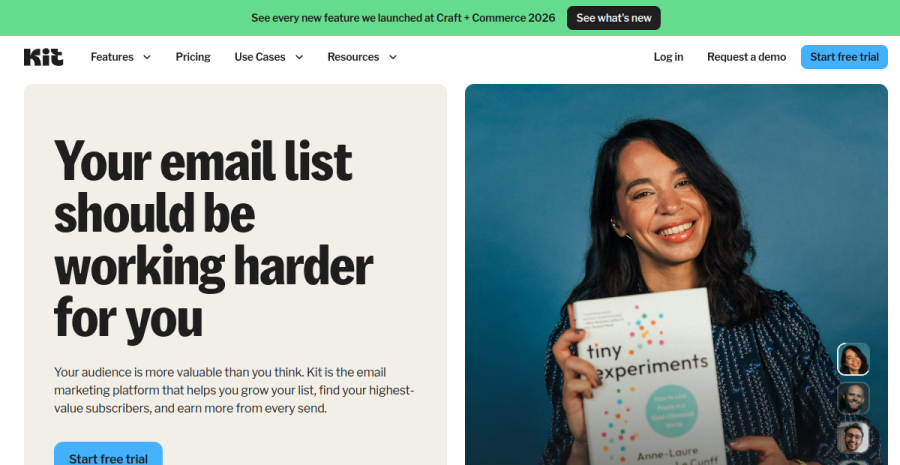
Kit was built for independent content businesses: newsletters, courses, communities. The philosophy shows in every feature — subscribers have tags and segments, not just columns in a spreadsheet; the automation builder is visual and approachable; the landing-page creator is clean enough to actually use.
The free tier is unusually generous. Up to 10,000 subscribers at no cost, including broadcast emails and one automation sequence. Most solos will never outgrow the free plan before they are making money. When you do upgrade, the paid tier adds unlimited automations, A/B tests and the Creator Network (a referral engine where Kit newsletters recommend each other).
Where it shows its limits. Kit is a US company with US servers — subscriber data crosses the Atlantic. There is a DPA, and they are GDPR-compliant, but if data residency is a hard requirement for your audience, look at Brevo or MailerLite instead. Transactional email (receipts, login links) needs a separate service like Postmark.
Worked example. A Tallinn-based solopreneur runs a weekly newsletter on EU tax structures for freelancers. They have 4,000 subscribers, sell a €197 OÜ setup guide, and send one broadcast per week plus a 5-email welcome sequence. Total monthly cost: €0. When the list hits 12,000 and they add a second automation for the course funnel, cost moves to ~€29/month — still reasonable against the revenue.
Pros: best-in-class creator features; most generous free tier; strong deliverability. Cons: US data centres; no built-in SMS; transactional email needs a third-party service.
2. Brevo (formerly Sendinblue) — EU-native, budget-first
Brevo
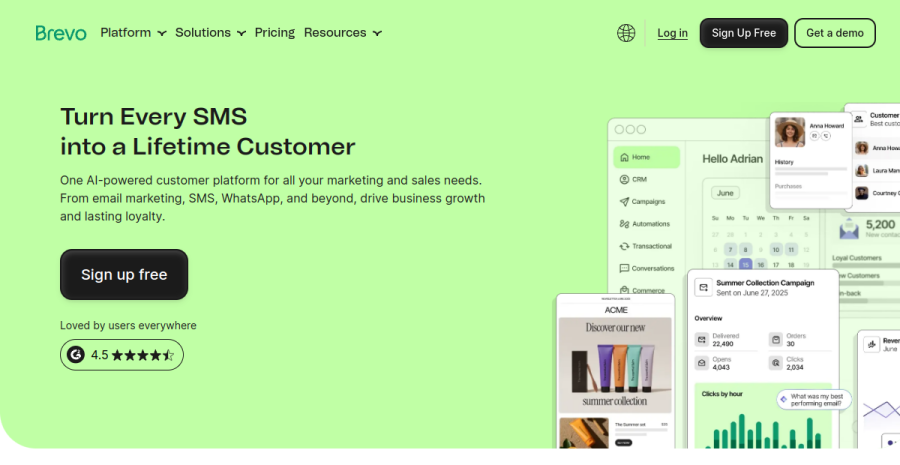
Brevo is a French company with servers in Paris. For an EU solopreneur dealing with a European B2C audience, that matters: your subscribers’ data stays inside the EU without any additional configuration, and the DPA is straightforward.
The pricing model is different. Brevo charges by emails sent, not subscribers. The free plan allows 300 emails per day (9,000/month) with no limit on how many contacts you store. That means a business with 5,000 subscribers sending one email per week fits comfortably on the free tier — the maths only breaks if you send frequently to a large list.
Full review: Brevo review for solopreneurs.
Beyond email. Brevo includes SMS marketing, WhatsApp campaigns and transactional email in the same platform. For a solo running a local service business or an e-commerce operation, the SMS channel is genuinely useful and rare at this price point.
The catch. Brevo’s automation builder and template editor lag behind Kit and MailerLite for sophistication. It works, but it feels more like an operations tool than a growth tool. Deliverability is solid but not exceptional on shared IPs — move to a dedicated IP if you send volume.
Worked example. A Lithuanian freelance photographer sends a monthly newsletter (1 send) plus 3 automated welcome emails to new enquiries. Subscriber count: 2,000. Monthly email sends: ~2,000 + 60 = ~2,100. Free tier covers it easily. If they add SMS for booking reminders to active clients (~200 SMS/month), cost is €8/month on the Starter plan.
Pros: EU data residency; emails-not-subscribers pricing; includes SMS; we are Brevo users ourselves (our contact form routes through Brevo’s transactional API). Cons: weaker automation UI; templates feel dated; deliverability on shared IPs varies.
From my own portfolio — the free 300/day goes faster than you think. I run Brevo’s transactional API across several projects, and the lesson the free tier teaches you the hard way is that the 300-emails-per-day allowance is shared by everything you send — not just newsletters. Magic-link logins, password resets, payment receipts, contact-form notifications all draw from the same daily bucket. A single launch day, or one project with a busy sign-up flow, can drain it before lunch — and once you hit the cap, the transactional emails your product depends on (the login link a user is waiting for) stop going out too. If email is load-bearing for your product and not just marketing, size the paid tier against your real daily peak, not your monthly average — and keep transactional and marketing sending mentally separate even when one tool handles both.
3. MailerLite — clean, EU-based, genuinely simple
MailerLite
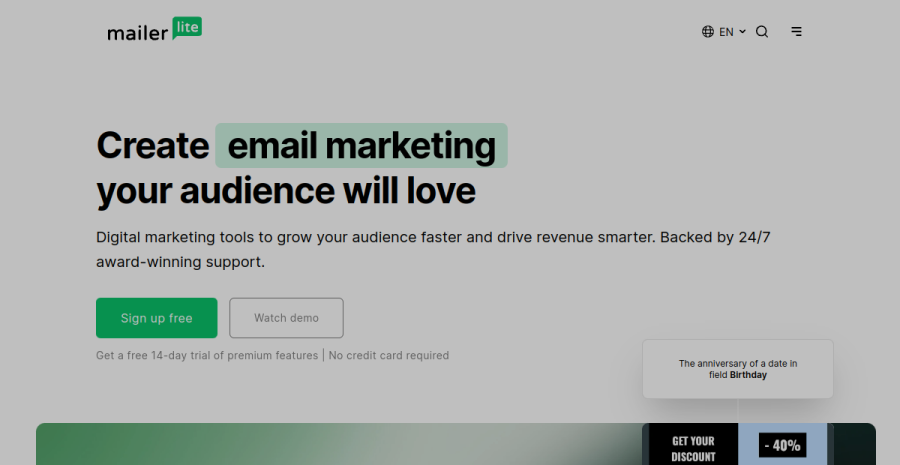
MailerLite is a Lithuanian company (Vilnius) that has consistently built one of the most accessible email tools in the market. The UI is the cleanest of the four here — landing pages, pop-ups, automations and A/B tests are all in one dashboard that does not require a course to navigate.
EU credentials. Like Brevo, MailerLite stores data in the EU and has a straightforward DPA. They were early to make double opt-in easy to enable (one toggle) and their compliance documentation is thorough — a practical advantage if you serve B2C audiences in stricter GDPR jurisdictions like Germany.
Free tier. 1,000 subscribers and 12,000 emails per month. Smaller than Kit’s, but the paid tier (from ~€10/month) is competitive and unlocks all automations, including a visual automation builder that rivals anything in this price range.
Where it falls short. MailerLite has no creator network or referral mechanics. It is excellent email software rather than a growth platform — if you want audience building tools beyond the list itself, Kit is ahead.
Worked example. A Berlin-based UX consultant sends a bi-weekly newsletter to 800 subscribers. Paid plan is unnecessary — free tier has 200 subscribers of headroom. When she launches a €299 UX audit service and adds a 4-email nurture sequence, she stays on the free plan. Cost at 800 subscribers doing 2 sends/week (6,400 emails/month): €0.
Pros: cleanest UI; EU data centres (Vilnius); competitive paid pricing; strong automations for the price. Cons: smaller free tier than Kit; no creator-network growth mechanics; no built-in SMS.
4. Systeme.io — when email is part of your funnel
Systeme.io
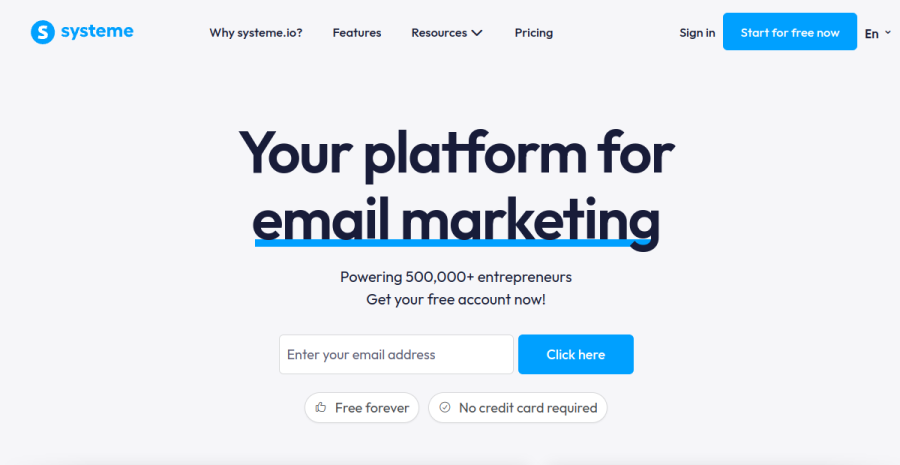
Systeme.io is not primarily an email tool — it is an all-in-one launch platform that includes email as part of the package. The free plan covers 2,000 contacts, unlimited emails, funnels, landing pages, one course and one product checkout. Nothing else at this price point bundles all of that.
When it makes sense. You are about to launch a digital product — a course, a membership, a template pack. You need a landing page, a checkout, an email confirmation sequence and a post-purchase nurture campaign. Setting all of that up in Kit + Stripe + Carrd takes a day of integration work. In Systeme.io, it is one flow in one dashboard.
The email trade-off. Systeme’s email is functional but not a creator platform. There is no equivalent to Kit’s subscriber tagging system or creator network. Deliverability is adequate for transactional and newsletter use, but heavy broadcasters report it is weaker than dedicated tools on cold lists. If your business is 80% email newsletter, Kit is the better fit. If email is the distribution layer for a product business, Systeme handles it without an additional subscription.
Which one should you start with?
| If you are… | Start with |
|---|---|
| Running a newsletter or content business | Kit (free to 10k subs) |
| Sending to a European B2C audience + want EU servers | Brevo or MailerLite |
| Launching a course or digital product soon | Systeme.io (funnel + email in one) |
| Already on Systeme for your funnel | Stay there — adding Kit later takes 20 minutes |
| Running a service business with local clients | Brevo (add SMS for €8/mo) |
The honest answer for most solopreneurs starting out: Kit for content, Systeme for products, Brevo or MailerLite if EU data residency is non-negotiable. All four have a free tier long enough to test properly before you spend anything.
EU footnote: what GDPR actually requires from your email tool
Every tool in this list is GDPR-compliant. What varies is where your data lives and how much work the compliance documentation requires. Practical checklist:
- Enable double opt-in — legally required for EU B2C audiences in most EU member states. All four tools support it; make sure it is turned on, not just available.
- Sign the DPA — every tool offers a Data Processing Agreement. Sign it. It takes three clicks and is required for GDPR compliance when using a processor.
- EU data centres — Brevo and MailerLite store data in the EU by default. Kit and Systeme.io use US infrastructure with standard contractual clauses for cross-border transfers. Both approaches are legal; EU residency simplifies documentation for German and Austrian audiences in particular.
- Unsubscribe must work — test it before launch. All four tools handle this automatically.
Deciding between two tools specifically? The head-to-heads: MailerLite vs Brevo — the two EU-native budget picks, side by side — and Kit vs MailerLite vs Brevo, the creator-first choice against the two EU tools. Launching a product rather than just a newsletter? The Systeme.io review covers email bundled inside a full funnel.
Is the newsletter itself the business? Then you’re choosing a publishing platform, not just an email tool — compare the best newsletter platforms (Substack vs beehiiv vs Kit vs Ghost) on revenue cut and ownership.
Cross-links: if you are building an email list to sell a product, read our payment processors roundup for the merchant-of-record layer. If you want email inside a complete launch stack, see our all-in-one platforms comparison. For the full five-tool stack a one-person business actually needs, see The five-tool stack.
Frequently asked questions
What is the best email marketing platform for a one-person business?
Is email marketing actually free for solopreneurs?
Do EU solopreneurs need GDPR-specific email marketing tools?
Should a solopreneur use a dedicated email tool or an all-in-one platform?
Keep reading
Best AI customer support tools for solopreneurs (2026): chatbots & live chat, honestly
For a one-person business the real question isn't 'which live chat' — it's whether you need chat at all, or an AI trained on your docs plus a great FAQ. Crisp, Tidio, Chatbase, Intercom and the free options compared, with the EU angle: a chat log is personal data.
Best form builders for solopreneurs (2026): Tally vs Typeform vs Jotform
Lead capture, intake forms, surveys, waitlists — the forms a one-person business runs on. Tally, Typeform, Jotform and Google Forms compared on cost, conversion and the one thing most guides skip: where your respondents’ data lives under GDPR.
MailerLite vs Brevo for solopreneurs (2026)
MailerLite vs Brevo for a one-person business — a clean, creator-friendly newsletter tool versus an EU-based multichannel marketing suite with SMS, a light CRM and transactional email. The honest fit-comparison, who each suits, and how the pricing models differ. From a team of one.
Everything here is free. If something saved you time, you can support the author — no product, no signup.