Best newsletter platforms for solopreneurs (2026): Substack vs beehiiv vs Kit vs Ghost
The best platforms to start and monetise a newsletter as a one-person business — Substack, beehiiv, Kit and Ghost compared on the two things that actually decide it: what they take from your subscription revenue, and how much you truly own. Plus the EU VAT catch nobody flags.

Solo operator · one-person venture studio in Europe (SEO · affiliate · micro-SaaS) · 16 July 2026 · updated 16 July 2026 · 7 min read

A newsletter is the rare online asset you genuinely own — no algorithm decides who sees it. But the platform you build it on decides two things that compound for years: how much of your paid revenue it takes, and how much you actually control if you ever want to leave. Those two questions — not the feature checklist — are what this compares, for a one-person business. And there’s an EU-specific catch underneath all of them that most roundups never mention.
How I evaluated these. For a solo, a newsletter platform should: be cheap (or free) to start, not tax your growth punitively, help you grow the free list (the real bottleneck), let you monetise when ready, and let you leave with your list and audience intact. Fees, tiers and cuts below are indicative 2026 and change often — verify on each platform’s page before committing.
At a glance
| Platform | Best for | Cut of subscription revenue | Ownership |
|---|---|---|---|
| Substack | Fastest start + built-in discovery | 10% + payment fees | Low (platform-owned network) |
| beehiiv | Best all-round for growth | 0% (flat SaaS fee) | Medium-high (export, own domain) |
| Kit | Automation + wider email business | 0% on subs (commerce fees apply) | High (your list, your automations) |
| Ghost | Full ownership, site + membership in one | 0% (flat/self-host) | Highest (open-source, self-hostable) |
| Buttondown | Minimalist, privacy-friendly | Low flat tiers | High (simple, portable) |
1. Substack — the fastest start, with a cut
Substack
Substack is the lowest-friction way to launch: sign up, write, and you have a newsletter with a public archive, a paid tier and a genuine discovery network (Notes, recommendations between publications) that can grow your list for you. You pay nothing until you charge — then it takes 10% of subscription revenue.
Pros: free until you monetise; effortless to start; real built-in audience discovery; strong reader-facing app and recommendations. Cons: the 10% cut scales with your success; you build on their network and own less; limited automation, design control and portability compared with the others.
Best for: writers who want to start today and lean on Substack’s discovery — accepting the cut and the lock-in as the price of simplicity.
2. beehiiv — the best all-round for a growing solo
beehiiv
Built by ex-Morning Brew operators, beehiiv is purpose-made for growing and monetising a newsletter as a business. It takes 0% of subscription revenue (flat monthly SaaS fee instead), has a generous free tier, serious growth tooling (referral program, recommendation network, SEO-friendly web archive) and its own ad network that pays you to run relevant sponsorships. For a solo who’s serious about growth and economics, it’s the sweet spot.
Pros: 0% of subscription revenue; strong free tier; best-in-class growth features; built-in monetisation (ads + subs); good analytics. Cons: flat fee from the paid tiers up (you pay whether or not you monetise); less “literary” than Substack; another dashboard to learn.
Best for: the solo treating the newsletter as a growth business who wants to keep the upside.
3. Kit (formerly ConvertKit) — automation for a wider email business
Kit
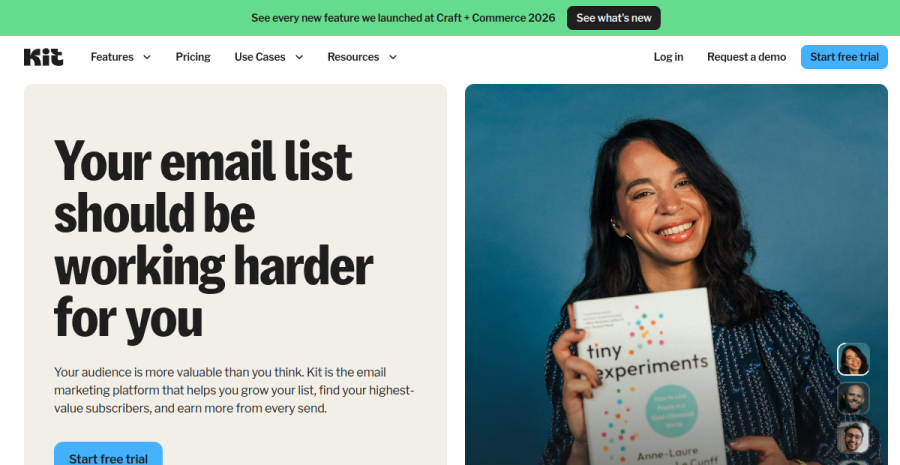
Kit is really a creator email-marketing platform that does newsletters well: powerful automations, tagging and segmentation, landing pages, and a Creator Network for cross-growth. It takes 0% of paid-newsletter subscriptions on its plans (commerce/sales carry a processing fee), and shines when the newsletter is one channel in a business that also sells products, courses or services.
Pros: best automation and segmentation of the group; sell products/subs alongside the list; strong deliverability and creator ecosystem; your list and logic are portable. Cons: more tool than editorial platform; the deepest features sit on paid tiers; overkill if you only want to write and send.
Best for: solos who want the newsletter and the machinery to sell around it. (See it beside the rest of the best email marketing tools.)
4. Ghost — the ownership pick (site + membership + newsletter)
Ghost
Ghost is open-source publishing software: a website, membership system and newsletter in one, with 0% taken from subscription revenue (you pay Stripe only). Self-host it for free for total control and data ownership, or use managed Ghost(Pro) for a flat fee. You own your domain, your design and your audience outright — the trade is that you set more up yourself.
Pros: maximum ownership and control; open-source, no revenue cut; one platform for site + membership + newsletter; own domain and data. Cons: more technical (especially self-hosted); no built-in discovery network like Substack/beehiiv; you drive your own growth.
Best for: solos who want to own the whole stack and don’t mind the setup for it.
5. Buttondown — the minimalist
Buttondown
A clean, minimal, privacy-respecting newsletter tool for people who want to write and send without a heavy dashboard. Simple pricing, markdown-first, portable — a solid choice if Substack feels too networked and beehiiv/Ghost feel too big.
Pros: minimal and fast; privacy-friendly; simple flat pricing; easy to leave. Cons: fewer growth and monetisation features; smaller ecosystem; essentials-focused by design.
Best for: minimalists who want the newsletter, not the platform around it.
How to choose
| If you… | Use |
|---|---|
| Want to start today, free, with built-in discovery | Substack |
| Are growing and want to keep your revenue | beehiiv |
| Want automation and to sell alongside the list | Kit |
| Want to own the whole stack (site + membership) | Ghost |
| Want a minimal, privacy-friendly tool | Buttondown |
The blunt version: Substack to start with zero cost and real discovery (accept the 10% and the lock-in); beehiiv once growth and economics matter (0% cut, ad network, generous free tier); Kit if the newsletter is one channel in a selling business; Ghost if you want to own everything. Most have a free tier — the honest move is to start on the one that removes your current bottleneck, and stay portable.
Where this fits
Choosing the tool is the easy 10%. The hard 90% is growing the free list (paid revenue is only a small percentage of it) and being consistent — that’s the real work, covered in how to build a paid newsletter and how to get traffic as a one-person business. Where a newsletter sits among the solo income models is in how solopreneurs make money.
Bottom line
For most solos: start on Substack if you value zero cost and discovery, move to (or start on) beehiiv if you’re serious about growth and keeping your revenue, choose Kit for automation-plus-selling, and Ghost to own the whole stack. Whichever you pick, the platform’s cut and your ownership matter more than the feature list — and in the EU, remember the VAT on paid subs is very likely yours to handle.
Read: how to build a paid newsletter →
Cross-links: the money model is in how to build a paid newsletter; if the newsletter serves a product or shop, compare the best email marketing tools; handling paid subs across the EU touches EU VAT & OSS.
Frequently asked questions
What is the best newsletter platform for a solopreneur?
Substack vs beehiiv vs Ghost — which takes less of my money?
Newsletter platform vs email marketing tool — what is the difference?
Do I have to handle EU VAT on paid newsletter subscriptions?
Keep reading
How to build a paid newsletter as a business (2026)
A newsletter is the audience you actually own. How paid newsletters make money, the platform cuts (Substack vs beehiiv vs Ghost), the conversion maths, and the EU VAT angle.
Can a solo actually make money with AI music (Suno)? The honest 2026 breakdown
AI music is real money for a one-person operation — but the divide is brutal: craft earns, spam gets deleted. The verifiable cases (a poet who turned Suno into a reported $3M deal, an AI act at #1, a Suno band past a million listeners), the honest economics, and the solo playbook that isn't spraying 500 tracks.
Case Lab: Justin Welsh's $10M solo creator business — what the number really means (2026)
Justin Welsh published a $10M cumulative journey from a one-person creator business — newsletter, courses and community at ~89% margin. We break down the case: the audience-to-product engine, the honest 'solo (with an asterisk)' truth, and why cumulative revenue isn't an annual salary.