Best AI customer support tools for solopreneurs (2026): chatbots & live chat, honestly
For a one-person business the real question isn't 'which live chat' — it's whether you need chat at all, or an AI trained on your docs plus a great FAQ. Crisp, Tidio, Chatbase, Intercom and the free options compared, with the EU angle: a chat log is personal data.

Solo operator · one-person venture studio in Europe (SEO · affiliate · micro-SaaS) · 11 August 2026 · updated 11 August 2026 · 6 min read

Every SaaS wants to sell you a chat bubble. For a one-person business, the honest first question isn’t “which live chat?” — it’s do you need chat at all, or do you need an AI that answers from your own content plus a great FAQ? An unattended widget that never replies is worse than no widget. Here’s the honest breakdown: when a bot earns its place, the picks that fit a solo, and the EU catch (a chat log is personal data).
How I evaluated these. For a solo, a support tool should: reduce the questions you answer manually (not add a channel you must monitor), be affordable at one-person scale, and handle EU data responsibly. Prices and AI features below are indicative 2026 and change — verify on each tool.
At a glance
| Tool | Best for | AI | EU note |
|---|---|---|---|
| Chatbase | Train a GPT on your own docs | ✅ core | US (SCCs/DPA) |
| Crisp | Best all-in-one for an EU solo | ✅ bot | EU-based (France) |
| Tidio | Small e-commerce (Lyro AI) | ✅ Lyro | EU/US |
| Intercom | Powerful, company-priced (Fin AI) | ✅ Fin | US (SCCs/DPA) |
| Tawk.to / Chatling | Free starting point | ➖ / ✅ | check per tool |
1. Chatbase — the AI-native pick (train it on your docs)
Chatbase
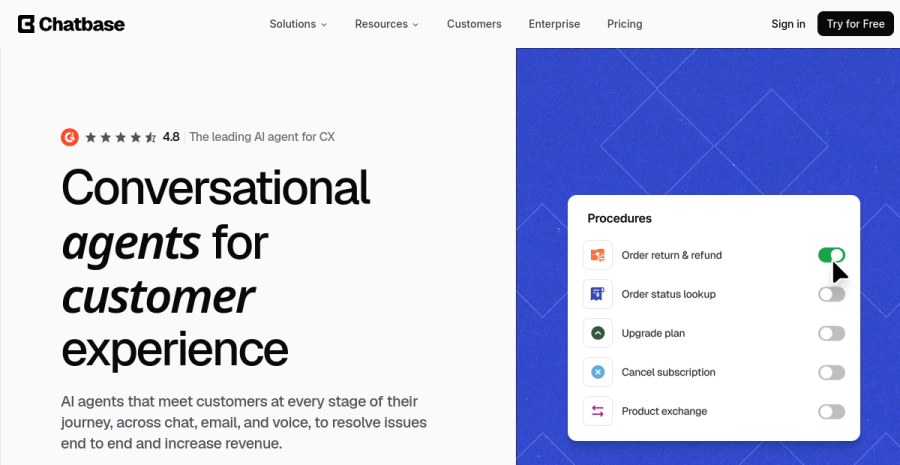
Chatbase is the most solo-appropriate idea in the category: you train a GPT on your own material — docs, FAQ, policies, a site crawl — and embed the resulting assistant, so it answers from your content instead of generic waffle. For a product or docs-heavy site, it deflects the repetitive questions automatically, 24/7, with no widget to staff.
Pros: answers from your real material; quick to set up; genuine deflection without you online; affordable. Cons: it’s answers, not a full inbox/CRM; quality depends on your docs; check where data is processed (US). Best for: solos with a product, app or docs who want instant, on-brand self-serve answers.
2. Crisp — the best all-in-one for an EU solo
Crisp

Crisp is a French company (a real EU data-residency plus) that bundles live chat, a shared inbox (email, chat, socials in one place), and a chatbot — at prices built for small businesses, not enterprises. For an EU solo who wants one tidy tool for all incoming messages with an EU-friendly compliance story, it’s the pragmatic all-in-one.
Pros: EU-based; chat + shared inbox + bot in one; affordable; clean app. Cons: the deepest AI/automation sits on paid tiers; still a channel you choose to monitor. Best for: EU solos who want one place for all messages, compliance made simpler by EU hosting.
3. Tidio — for a small e-commerce store
Tidio
Tidio is aimed at small e-commerce, with its Lyro AI answering common shopper questions and recovering sales at the point of purchase. If you run a small store where instant answers (“where’s my order?”, “does it ship to X?”) rescue conversions, Tidio fits that job specifically.
Pros: e-commerce-focused; Lyro AI for shopper questions; free tier to start. Cons: most valuable on paid tiers; more than a service-only solo needs. Best for: small online stores wanting AI answers at the buying moment.
4. Intercom — powerful, but priced for companies
Intercom
Intercom is the category heavyweight, and its Fin AI agent is genuinely strong at resolving tickets. But it’s built and priced for support teams — for a one-person business it’s usually far more platform (and cost) than the job needs. Worth knowing exists; rarely the right first pick for a solo.
Pros: most capable AI resolution; deep product. Cons: company pricing; overkill for one person. Best for: a solo scaling toward a real support load who’ll grow into it — most won’t, yet.
5. Tawk.to & Chatling — the free start
Tawk.to
Tawk.to is a genuinely free live-chat widget (it monetizes via add-ons), fine as a starting point if you just want a contact channel. Chatling is a low-cost AI chatbot builder if you want simple AI answers cheaply. Both are reasonable to start with — just don’t leave a live widget unmanned.
Pros: free / very cheap to start; quick to add. Cons: basic; an unmanned live widget can hurt more than help. Best for: a starting site that wants a contact option at zero cost.
How to choose
| If you… | Use |
|---|---|
| Have a product/docs and want instant self-serve answers | Chatbase |
| Want one EU-based tool for all messages | Crisp |
| Run a small online store | Tidio |
| Are scaling toward a real support load | Intercom |
| Just want a free contact channel | Tawk.to / Chatling |
The blunt version: most solos should train an AI on their docs (Chatbase) and write a great FAQ before adding live chat at all. If you want one tidy EU tool for every message, Crisp; for a small store, Tidio; grow into Intercom only when a real support load arrives. And never leave a live-chat bubble that nobody answers — an ignored chat is worse than none.
Where this fits
Support is one square of the AI stack — the “answer the repetitive stuff” corner. The function-by-function view is how solopreneurs use AI; the broader toolset is the best AI tools for solopreneurs. Where the conversations should land — the customer record and follow-up — is your CRM.
Bottom line
For most solos: train an AI on your own docs (Chatbase) and write a real FAQ before you add live chat. If you want one EU-based tool for every message, Crisp; for a small store, Tidio; Intercom only when a genuine support load arrives; Tawk.to/Chatling to start free. The tool matters less than the discipline: deflect the repeats automatically, keep a human path, and treat every chat log as the personal data it is.
How solopreneurs actually use AI →
Cross-links: the whole AI stack is best AI tools for solopreneurs; using AI in practice is how solopreneurs use AI; conversations should feed your CRM, and because chat logs are personal data, read GDPR for solopreneurs.
Frequently asked questions
Does a solopreneur even need a customer support chatbot?
What is the best AI customer support tool for a one-person business?
Is an AI chatbot GDPR-compliant — chat logs and personal data?
AI chatbot vs just using AI to draft email replies — which is better for a solo?
Keep reading
ChatGPT vs Claude for solopreneurs (2026): which AI should you pay for?
ChatGPT vs Claude, decided for a one-person business on a €20/month budget — not a benchmark leaderboard. Where each genuinely pulls ahead for a solo (writing, coding, research, ecosystem), how to pick one, and the EU data rule that applies to both.
Best AI meeting notetakers for solopreneurs (2026): auto-notes from client calls
For a solo consultant, coach or freelancer, an AI notetaker turns every client call into a transcript, summary and action list — so you can listen instead of scribble. Fathom, Fireflies, Otter, tl;dv and Granola compared, plus the GDPR recording-consent rule you must not skip.
Best form builders for solopreneurs (2026): Tally vs Typeform vs Jotform
Lead capture, intake forms, surveys, waitlists — the forms a one-person business runs on. Tally, Typeform, Jotform and Google Forms compared on cost, conversion and the one thing most guides skip: where your respondents’ data lives under GDPR.
Everything here is free. If something saved you time, you can support the author — no product, no signup.