The best email marketing tool for a one-person business (2026): Kit vs MailerLite vs Brevo
Which email marketing tool a solopreneur should actually pay for, and the one thing that decides your bill: whether you are charged per subscriber or per email sent. Kit vs MailerLite vs Brevo for a one-person business — a creator-first tool, a value all-rounder and an all-in-one with a generous free send, compared on pricing model, free tier and the solo use case. EU-first and honest.

Solo operator · one-person venture studio in Europe (SEO · affiliate · micro-SaaS) · 24 June 2026 · updated 24 June 2026 · 9 min read

Three names come up again and again when a solopreneur asks which email tool to use: Kit (formerly ConvertKit), MailerLite and Brevo (formerly Sendinblue). They are all good. That is exactly why the choice paralyses people — there is no obviously wrong answer, so it is easy to spend a week comparing feature grids instead of writing the first email. This piece narrows it down from a team of one chair: not which tool wins a spec sheet, but which one fits what you are actually building. If you want the wider field including Systeme.io, that is in the best email marketing tools for solopreneurs roundup; this is the three-way head-to-head.
How I compared these. I weighed four things a solo actually feels: the pricing model (this is the big one — see below), the free tier and how long it lasts, EU and GDPR stance (an EU audience leans toward EU servers), and fit for the solo job — creator growth, simple sending, or all-in-one breadth. I am not scoring enterprise depth a one-person business will never touch. Every price, subscriber limit and send allowance below is indicative — check the current plans, because vendors move these around constantly and a stale number is worse than none.
The one thing that decides your bill
Before any feature talk: Kit and MailerLite price by subscriber count; Brevo prices by emails sent. For a solo, that single difference usually decides the cost more than any plan tier does.
- A large list you email rarely — say a few thousand subscribers and one send a month — is expensive on a subscriber-priced tool (you pay for every stored contact) but cheap on Brevo (it only counts emails that go out).
- A small list you email often — daily sends to a few hundred people — sits cheaply on a subscriber plan but can chew through a send-based allowance fast.
So the honest first step is not “which is best” but “what does my list and my sending actually look like?” Estimate both your list size and your monthly send volume, then read the prices — because the three tools are not even measuring the same thing.
Comparison at a glance
| Kit | MailerLite | Brevo | |
|---|---|---|---|
| Best for | Creators & paid newsletters | Value all-rounder | All-in-one + big free send |
| Pricing model | By subscriber count | By subscriber count | By emails sent |
| Free tier | Generous on subscribers | Smaller subscriber cap | Capped daily sends, no contact cap |
| EU data residency | ❌ US-based | ✅ EU | ✅ EU |
| Standout feature | Creator growth network | Clean UI, low cost | SMS + transactional in one |
| Weak spot | US data, no SMS | No growth/referral tools | Plainer automation UI |
| Indicative rating | 4.5 | 4.4 | 4.2 |
All figures indicative — confirm current plans on each vendor’s site.
The three, in detail
Kit (formerly ConvertKit)
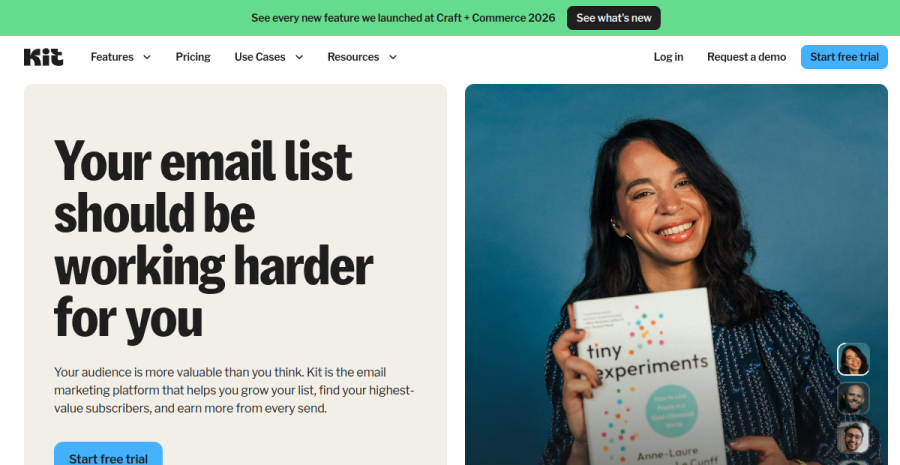
Kit is built for people whose business is their audience — newsletters, courses, paid subscriptions, digital products. The creator DNA shows everywhere: subscribers carry tags and segments rather than living as rows in a list, the visual automation builder is approachable, and the landing-page and paid-newsletter tooling is clean enough to actually use without a developer. The recommendation network — where Kit newsletters refer readers to each other — is a genuine growth lever you simply do not get from a plain email tool.
The trade-offs are real and worth naming. Kit is US-based, so subscriber data crosses the Atlantic; there is a DPA and it is GDPR-compatible, but if EU data residency is a hard line for your audience, MailerLite or Brevo fit better. There is no built-in SMS, and transactional email (receipts, login links) wants a separate service. And because it prices by subscriber count, a big list you rarely email is paying for every stored contact. It earns that price once you are monetising the audience — which is the whole point of building a paid newsletter.
Pros: best-in-class creator and paid-subscription features; growth/recommendation network; generous free tier; strong deliverability. Cons: US data centres; subscriber-based pricing punishes large quiet lists; no SMS.
Best for: the solo whose audience is the product — newsletter, course or paid-subscription creators.
MailerLite
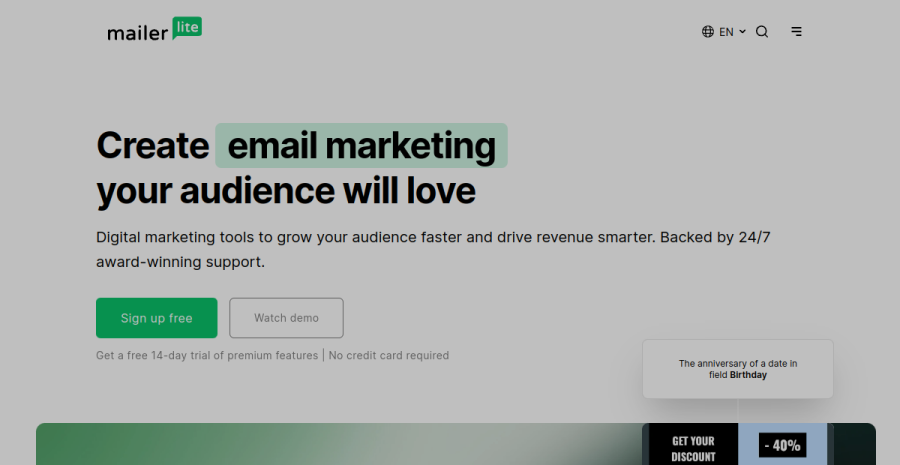
MailerLite is the one I point most solos to when they just want email done well without overthinking it. It is an EU company, stores data in the EU, and has the cleanest interface of the three — landing pages, pop-ups, automations and A/B tests sit in one dashboard that does not need a course to navigate. Double opt-in is a single toggle and the compliance documentation is thorough, which is a quiet but real advantage if your audience sits in stricter GDPR jurisdictions.
Its free tier caps subscribers more tightly than Kit’s, but the paid tier is genuinely low-cost and unlocks a visual automation builder that punches above its price. Like Kit, it prices by subscriber count, so the same caveat applies to a large, infrequently-emailed list. The honest limitation is scope: MailerLite is excellent email software rather than a growth platform — there is no recommendation network or referral mechanic. If your goal is to grow the audience itself rather than just send to it well, Kit is ahead. For everyone else building a list off the back of content marketing, MailerLite is the value pick.
Pros: cleanest UI; EU data residency; low-cost paid tier; strong automations for the money. Cons: smaller free subscriber cap than Kit; no growth/referral tools; no built-in SMS.
Best for: the solo who wants affordable, EU-based, no-drama email — the safe default.
Brevo (formerly Sendinblue)
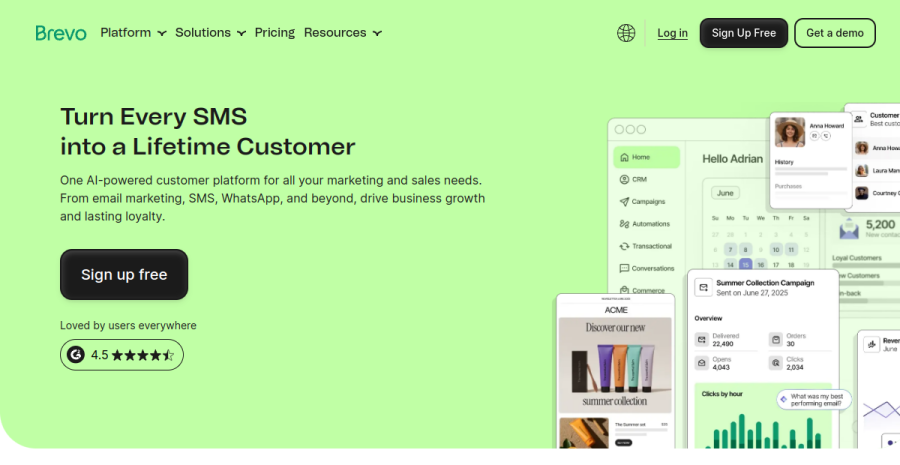
Brevo is the odd one out, in a useful way. It is a French company with EU data residency, and — crucially — it prices by emails sent, not contacts stored. Its free tier caps daily sends rather than subscriber count, so a business storing a large list but emailing it infrequently fits comfortably where a subscriber-priced tool would already be charging. It also bundles SMS, WhatsApp campaigns and transactional email into the same platform, which is rare at this price and genuinely handy for a local-service or e-commerce solo.
The catch is polish. Brevo’s automation builder and templates lag behind Kit and MailerLite — it works, but it feels more like an operations tool than a growth tool. And the send-based model cuts both ways: a small list you email daily can drain a send allowance faster than you expect, and one busy day can eat a free-tier cap. There is a portfolio lesson here worth heeding — that daily send bucket is shared by everything the platform sends for you, marketing and transactional alike, so if email is load-bearing for your product, size the paid tier against your real daily peak, not your monthly average.
Pros: EU data residency; pay-by-emails-sent suits large quiet lists; SMS and transactional in one login; generous free send. Cons: plainer automation and template UI; send-based model can surprise frequent senders; no creator growth features.
Best for: the solo with a big-but-quiet list, or who wants email, SMS and transactional under one roof.
If you send a lot and the list is big (shops, Etsy sellers, bulk senders)
This is where the billing model stops being a detail. A per-subscriber tool bills you for every address on the list whether you mail it or not; a per-send tool bills you only for what goes out. So a seller with a few thousand past customers who sends one campaign a month is usually cheaper on a send-based plan, while a creator mailing a weekly letter to the same list is usually cheaper on a subscriber-based one.
Two things that quietly change the answer: transactional email (order confirmations, receipts) counts as sends too, so an all-in-one that covers both can beat a cheaper newsletter tool plus a separate sender; and a free tier with a daily send cap is fine for drip automation and useless for a single large blast. Work out your real monthly send volume first — the rest of this comparison is only useful after that number.
Which should you choose?
| If you are… | Choose |
|---|---|
| Building an audience as the business — newsletter, course, paid subscription | Kit |
| Wanting affordable, EU-based email done well, no fuss | MailerLite |
| Storing a large list you email infrequently | Brevo (send-based pricing wins here) |
| Running a local service and want SMS + email together | Brevo |
| Just starting and unsure | MailerLite — easiest to grow into |
The blunt version: Kit if your audience is the product, MailerLite as the value default, Brevo when your list is large-and-quiet or you want SMS in the mix. All three have a real free tier, so you can test deliverability and workflow with actual subscribers before paying anything.
And do not let the comparison become the project. The tool matters far less than the act of getting people onto a list you own — the first step is always building the list from scratch, and any of these three will carry it. Pick one this week, import your contacts, send the first email. You can switch later in an afternoon; you cannot get back the months you spent deciding.
Cross-links: down to just the two EU budget picks? See MailerLite vs Brevo head-to-head. For the full field, best email marketing tools for solopreneurs; get the list started with how to build an email list from scratch, and turn it into income with how to build a paid newsletter.
Frequently asked questions
Kit vs MailerLite vs Brevo — which is best for a solopreneur?
Why does the pricing model matter more than the price?
Are the free tiers genuinely usable, or just trials?
Do EU solopreneurs need an EU-based email tool?
Keep reading
MailerLite vs Brevo for solopreneurs (2026)
MailerLite vs Brevo for a one-person business — a clean, creator-friendly newsletter tool versus an EU-based multichannel marketing suite with SMS, a light CRM and transactional email. The honest fit-comparison, who each suits, and how the pricing models differ. From a team of one.
Brevo review (2026): the email tool I actually run across my projects
An honest, first-hand Brevo review for solopreneurs — why I use it across multiple projects, the pay-by-emails-sent model, EU data residency, where deliverability genuinely wins, and the real catch with its automation and send limits.
How to build an email list from scratch (solo, 2026)
A rented social audience can vanish overnight; an email list you own. The honest, EU-aware playbook for a one-person business: a useful lead magnet, GDPR-clean consent, where to put forms, and your first subscribers with no audience yet.
Everything here is free. If something saved you time, you can support the author — no product, no signup.