Stripe vs Paddle vs Lemon Squeezy (2026)
How an EU solo should take payment for digital products — Stripe, Paddle and Lemon Squeezy compared on the one decision that matters: control with your own VAT responsibility (Stripe) versus a merchant of record that becomes the seller and handles VAT for you (Paddle, Lemon Squeezy). Honest, EU-first, not advice.

Solo operator · one-person venture studio in Europe (SEO · affiliate · micro-SaaS) · 24 June 2026 · updated 24 June 2026 · 7 min read

You have built a digital product — a template pack, a course, an ebook, a small SaaS — and now you need to take money for it. For a team of one in Europe, the checkout button is the easy part. The hard part hides behind it: the moment you sell a digital product to a consumer in another EU country, VAT becomes your problem, and how you take payment decides whether that problem is yours or someone else’s. That single distinction — not the colour of the checkout — is what separates Stripe from Paddle and Lemon Squeezy. Here is how to choose, EU-first.
If you are still deciding what to sell and how to package it, start with how to sell digital products and templates; this review is about the payment layer underneath it.
How I compared these. From a solo’s chair, selling digital products across EU borders: who is responsible for VAT, how much admin lands on me, how much control I keep over the checkout and the customer relationship, and what it costs. I’m weighting compliance and time, not feature maximalism. Fees move and differ by region and product — every figure below is indicative; confirm current pricing on each provider’s own page before deciding.
The shortlist at a glance
| Provider | Model | Who owns EU VAT | Best for | Fee |
|---|---|---|---|---|
| Stripe | Payment processor (PSP) | You (register + file OSS) | Maximum control & flexibility | Per-transaction % (indicative) |
| Paddle | Merchant of record | Paddle (handles it) | Done-for-you VAT, SaaS-friendly | Per-transaction % (indicative, higher) |
| Lemon Squeezy | Merchant of record | Lemon Squeezy (handles it) | Simple MoR for indie digital products | Per-transaction % (indicative, higher) |
Stripe
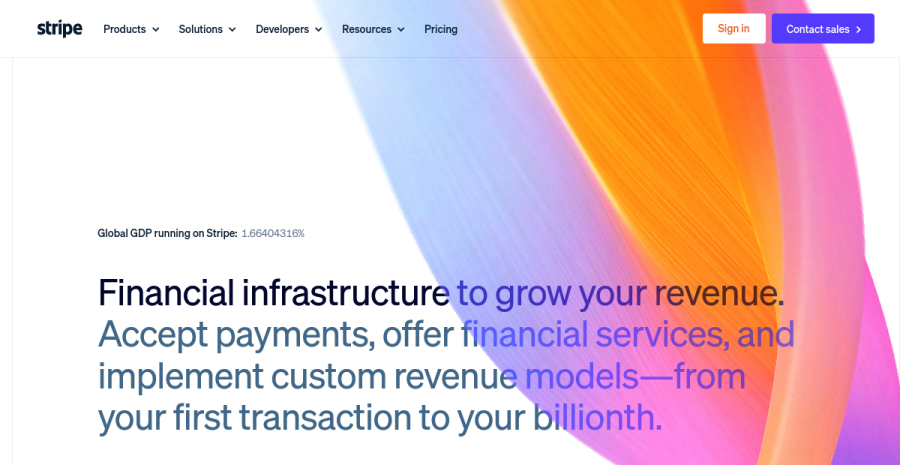
Stripe is the developer-favourite payment processor, and the most powerful, flexible option here — but read the model carefully. Stripe processes the payment; it does not become the seller. That means you are the merchant of record, and EU VAT is your responsibility: register for OSS, charge the right rate per country, keep location evidence, file the returns. Stripe Tax (a paid add-on) automates the rate calculation and collection and removes a lot of the pain, but you are still the seller filing the returns. In return you get the lowest typical fee of the three, complete control of the checkout, full ownership of customer data, and an enormous ecosystem of integrations.
Pros: lowest indicative fee; total control over checkout, billing logic and data; vast integrations and excellent docs; Stripe Tax can automate VAT calculation. Cons: you own EU VAT registration, OSS filing and compliance; more setup; the tax work doesn’t disappear, it just gets tooled.
Best for: solos who want control and lower fees and are willing to run their own VAT (ideally with an accountant or Stripe Tax behind them).
Paddle
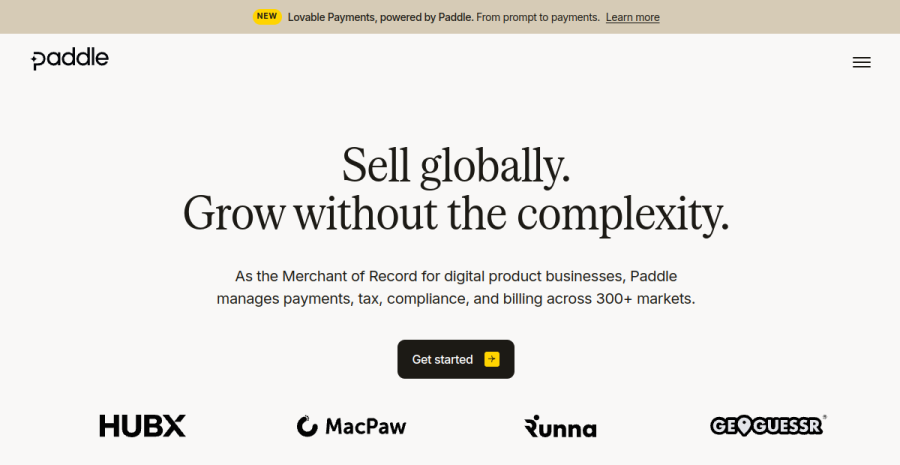
Paddle is a merchant of record built for software and SaaS: it legally becomes the seller, so it calculates, collects and remits VAT and sales tax worldwide, handles compliant invoicing, and deals with the tax registrations you would otherwise carry yourself. For an EU solo selling a subscription product internationally, that removes the single biggest admin burden — you never touch an OSS return for sales that run through Paddle. The trade is a higher all-in percentage and less granular control of the checkout than raw Stripe, plus it’s more oriented to SaaS/subscriptions than to one-off digital downloads.
Pros: merchant of record — VAT/sales tax handled and remitted for you; strong for SaaS and subscriptions; compliant invoicing built in; one bill, no OSS filing. Cons: higher indicative fee than Stripe; less checkout control; geared more to software than simple one-off products.
Best for: solos selling SaaS or subscription software who want VAT and global tax handled done-for-you.
Lemon Squeezy
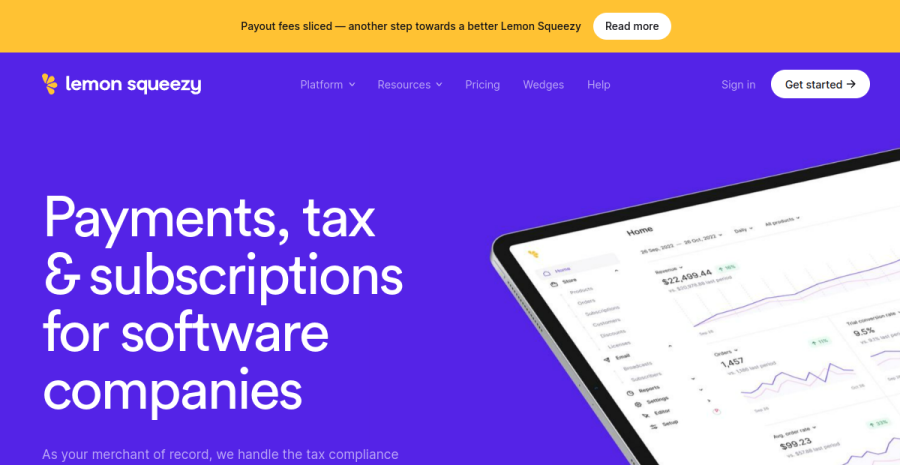
Lemon Squeezy is the merchant-of-record option aimed squarely at indie makers selling digital products — templates, ebooks, courses, licences, small tools. Like Paddle, it becomes the seller of record and handles VAT and sales tax collection and remittance for you, so an EU solo can sell across borders without registering for OSS. The pitch versus Paddle is simplicity: a friendlier, faster setup tuned for one-off digital goods and small product catalogues rather than complex SaaS billing. You pay the typical MoR premium over Stripe, and you accept a more packaged checkout — which is exactly the point for someone who wants to ship and not fiddle.
Pros: merchant of record — VAT handled for you; built for indie digital products and quick setup; clean, simple selling flow; good fit for templates/courses/downloads. Cons: higher indicative fee than Stripe; less control than rolling your own Stripe checkout; less suited to heavy custom billing.
Best for: indie solos selling one-off digital products who want done-for-you VAT and the least fuss.
Which should you choose
The honest answer is the model, not the logo. Work it in this order:
- Do you want to never deal with EU VAT? Choose a merchant of record — Lemon Squeezy for one-off digital products (templates, ebooks, courses), Paddle if you’re selling SaaS or subscriptions. They become the seller and handle the tax, full stop.
- Do you want maximum control and the lowest fee, and can you run your own VAT? Choose Stripe — ideally with Stripe Tax and/or an accountant handling your OSS filings. You keep the data, the checkout and the economics; you also keep the paperwork.
- Selling subscriptions vs one-off downloads? Paddle leans SaaS; Lemon Squeezy leans indie digital goods; Stripe does both but hands you the VAT either way.
- Thin margins / high volume? The lower Stripe fee plus your own VAT setup can beat the MoR premium — but only if you’ll actually do (or automate) the filing. Run it on your real numbers.
The blunt version: if VAT admin is the thing you’re trying to avoid, pay the merchant-of-record premium and use Lemon Squeezy or Paddle; if control and cost matter more and you’ll handle compliance, use Stripe. There’s no wrong pick here — only the wrong model for your appetite for tax admin.
If you’d rather not bolt a payment layer onto your own site at all, some all-in-one launch tools bundle checkout, hosting and (sometimes) merchant-of-record handling — see the best all-in-one platforms to launch solo in the EU. And for the wider field of checkout options beyond these three, the best payment processors for digital products in the EU goes broader.
Not tax advice — I’m a solo comparing tools, not your accountant. Whichever you pick, confirm your own VAT position before you launch: the VAT OSS explainer covers the rules a Stripe seller must follow, and the how to sell digital products and templates guide covers the product side.
Frequently asked questions
What is the difference between Stripe, Paddle and Lemon Squeezy for an EU solo?
Do I have to register for VAT to sell digital products in the EU?
Is a merchant of record worth the higher fee?
Can I use Stripe and still stay compliant with EU VAT?
Keep reading
What is a merchant of record? (and when a solo seller needs one) — 2026
A merchant of record is the entity legally responsible for the sale to your customer — it collects and remits sales tax and VAT worldwide and pays you a payout. Here is how an MoR differs from a plain payment processor, the trade-off it asks of you, and when a solo digital seller actually needs one.
Stripe review (2026): the payment stack I run for SaaS and one-off sales
A first-hand Stripe review for solopreneurs — running subscriptions and one-off client charges, weekly payouts, flexible coupons, easy verification, and the real gotchas (you own EU VAT, and webhooks across multiple projects can cross wires).
France e-invoicing 2026: what a micro-entrepreneur must do by 1 September 2026 (and by 2027)
From 1 September 2026 every French business, micro-entrepreneurs included, must be able to receive electronic invoices through an accredited platform; issuing becomes mandatory for small businesses on 1 September 2027. What the reform means for a one-person business, what a plateforme agréée is, and the two decisions to make now.
Everything here is free. If something saved you time, you can support the author — no product, no signup.