Beste Buchhaltungssoftware für Freelancer 2026: the best accounting software for German freelancers
The best accounting software (Buchhaltungssoftware) for German freelancers and Freiberufler in 2026 — sevDesk, lexoffice, Accountable and Norman compared. Kleinunternehmer-friendly, ELSTER-ready, with an honest look at which tools actually offer English support for expats.

Solo operator · one-person venture studio in Europe (SEO · affiliate · micro-SaaS) · 12 June 2026 · updated 8 July 2026 · 11 min read

If you are freelancing in Germany — whether you are a German Freiberufler, a registered Gewerbetreibende, or an expat who just got their first Steuernummer — the accounting tool you pick is not a cosmetic choice. It decides whether your quarterly USt-Voranmeldung takes ten minutes or a panicked evening, whether your year-end EÜR lands cleanly in ELSTER, and whether you understand a single word of the screen you are filing from. German bureaucracy is unforgiving and specific; the right software absorbs most of that pain for the price of a couple of coffees a month.
How I evaluated these. I judged each tool on the things that actually matter to a solo self-employed person in Germany, not a US-centric feature checklist:
- EÜR — does it produce the Einnahmenüberschussrechnung (the simple cash-basis P&L most freelancers file) automatically from your invoices and expenses?
- ELSTER / Finanzamt submission — can it file the USt-Voranmeldung (and ideally the EÜR) electronically to the tax office, or do you re-key everything into the ELSTER portal?
- USt / VAT + Kleinunternehmer — does it correctly handle the Kleinunternehmerregelung (§19 UStG, no VAT charged) and switch cleanly to standard 19%/7% VAT when you grow past it?
- 2025 e-invoicing mandate — Germany made structured E-Rechnung (XRechnung / ZUGFeRD) receiving mandatory for B2B from January 2025, with sending obligations phasing in. Does the tool create and read these formats?
- English support — can an expat run the whole thing in English, with English help when the Finanzamt sends a confusing letter?
Tax figures and thresholds below are approximate 2026 public numbers — always verify current rates with the vendor or a Steuerberater before you rely on them.
Buchhaltungssoftware für Freelancer: at a glance
| Tool | Language | EÜR | ELSTER filing | Kleinunternehmer | E-invoicing (2025) | From |
|---|---|---|---|---|---|---|
| sevDesk | German | ✅ | ✅ direct | ✅ | ✅ XRechnung + ZUGFeRD | ~€8–20/mo |
| lexoffice | German | ✅ | ✅ direct | ✅ | ✅ XRechnung + ZUGFeRD | ~€8–20/mo |
| Accountable | English | ✅ | ✅ direct | ✅ | ✅ | ~€0–20/mo |
| Norman | English | ✅ | ⚠️ expanding | ✅ | ✅ | ~€0–15/mo |
1. sevDesk — the all-round bookkeeping winner
sevDesk
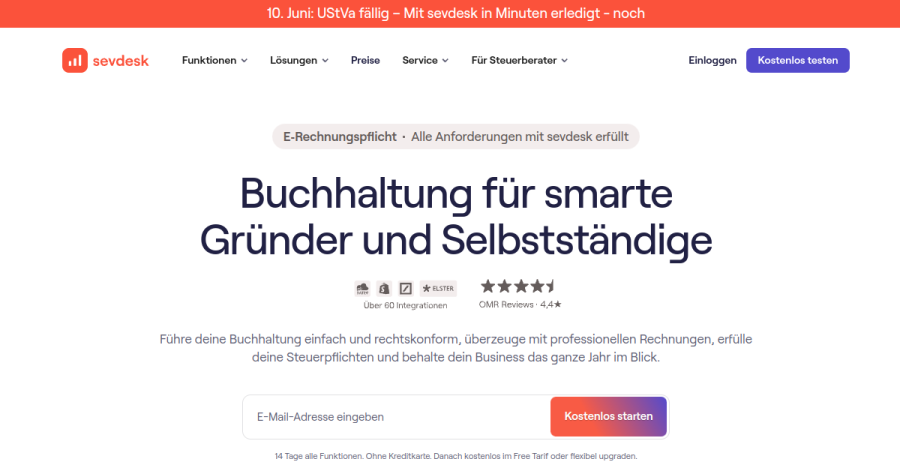
sevDesk is the tool I reach for first when a German freelancer wants one app that does everything — invoicing, expense capture, bookkeeping and tax filing — without bolting three products together. It builds your EÜR automatically from the transactions you have already booked, generates the USt-Voranmeldung, and submits it straight to ELSTER, so the Finanzamt deadline becomes a couple of clicks rather than a re-typing exercise.
Strong on the 2025 e-invoicing mandate. sevDesk creates and receives structured E-Rechnung (XRechnung and ZUGFeRD), which is exactly what you now need for B2B invoicing in Germany. Receipt OCR is genuinely good — photograph a Beleg, and it reads the amount, date and VAT for you and files it against the right account.
Kleinunternehmer-aware. Flag yourself under §19 UStG and sevDesk suppresses VAT on your invoices and adds the required legal note automatically. When you cross the threshold and switch to charging 19% (or 7%), the change is a setting, not a rebuild.
Worked example. A Cologne freelance developer on the standard VAT regime sends ~12 invoices a month and photographs every expense receipt. sevDesk books them, produces the monthly USt-Voranmeldung, files it to ELSTER, and has the EÜR ready at year end to hand to their Steuerberater (or to file themselves). Cost: roughly €16–20/month on a mid tier — verify the current plan.
Pros: most complete all-rounder; excellent receipt OCR; solid XRechnung/ZUGFeRD support; clean direct ELSTER filing; DATEV export your accountant will accept. Cons: the interface is German-only — fine for German speakers, a real barrier for expats who do not yet read tax German comfortably.
2. lexoffice (Lexware Office) — the German default, decade-proven
lexoffice (Lexware Office)
lexoffice — now rebranded Lexware Office — is the incumbent. It comes from Haufe-Lexware, a house that has sold German accounting software for decades, and that pedigree shows in how deeply it is wired into the German financial system: bank connections to nearly every German institution, and a DATEV export that the overwhelming majority of Steuerberater already work with daily.
Why “decade-proven” matters. If your accountant has a preferred tool, there is a strong chance it is lexoffice. That makes the year-end handover frictionless: they pull your DATEV export and your EÜR without asking you to reformat anything. For a freelancer who outsources the annual return, that smoothness is worth more than a slicker UI.
The German essentials are all there. Automatic EÜR, USt-Voranmeldung generation, direct ELSTER submission, full Kleinunternehmerregelung support, and XRechnung / ZUGFeRD e-invoicing for the 2025 mandate. Feature-for-feature it sits neck-and-neck with sevDesk.
Worked example. A Munich freelance translator who already works with a Steuerberater uses lexoffice purely so the handover is clean. They invoice in-app, let the bank feed reconcile payments, and export DATEV at year end. The accountant does the rest. Cost: roughly €12–17/month depending on tier — verify current pricing.
Pros: deepest German bank and DATEV integration; the tool your Steuerberater most likely already uses; mature, reliable, well-supported; full ELSTER and e-invoicing coverage. Cons: German-only interface, same expat barrier as sevDesk; the rebrand to “Lexware Office” has caused some naming confusion; UI feels a little more utilitarian than sevDesk’s.
3. Accountable — English-first, built for freelancer tax
Accountable

Accountable exists for the freelancer that sevDesk and lexoffice quietly leave behind: the one who does not read tax German. The entire app runs in English (and German, French), and it is built specifically for solo self-employed people rather than small companies — so it does not drown you in features a one-person business never touches.
It still files the German way. Accountable produces your EÜR, prepares the USt-Voranmeldung, handles the Kleinunternehmerregelung, and submits to ELSTER electronically — just with English labels and English explanations of what each German tax term means. For an expat, that translation layer is the whole value proposition: you are filing real German taxes without guessing at vocabulary.
Good guidance, real support. The app nudges you toward deductible expenses and flags deadlines, and the support team answers tax-adjacent questions in English — the kind of help that, with a German-only tool, would otherwise mean paying a Steuerberater for a five-minute answer.
Worked example. A Berlin-based expat designer, freshly registered and on the Kleinunternehmerregelung, sends ~6 invoices a month. Accountable issues them VAT-free with the correct §19 note, tracks expenses, and files the (zero-VAT) returns to ELSTER — all in English. Cost: a free tier for low volume, scaling to roughly €10–20/month as they grow. Verify current limits.
Pros: fully English (and multilingual); purpose-built for solo freelancers; strong tax guidance and English support; direct ELSTER filing; Kleinunternehmer-friendly. Cons: a younger product than the two incumbents — a smaller ecosystem, and a Steuerberater is less likely to be familiar with it, so confirm the DATEV/export handover suits your accountant.
4. Norman — modern, English, refreshingly simple
Norman
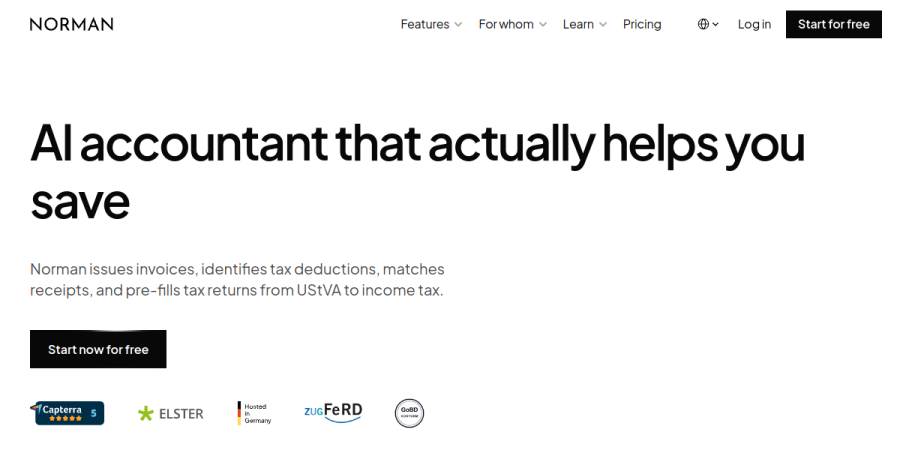
Norman is the newest face here — a clean, modern, English-language tax and accounting app aimed squarely at freelancers and small businesses in Germany who want the minimum viable amount of bookkeeping software. Where sevDesk gives you everything, Norman gives you the essentials with a short learning curve, which is exactly right for a freelancer whose accounting is not complicated.
English, simple, and German-compliant. The interface and support are in English. It handles invoicing (including e-invoice formats for the 2025 mandate), expense tracking, VAT and the Kleinunternehmerregelung, and prepares your tax filings including the EÜR and USt-Voranmeldung.
Where to be careful. As the youngest tool, Norman’s direct-to-ELSTER filing and deeper features are still expanding. For a simple Kleinunternehmer or low-volume freelancer it is more than enough; if you have complex VAT situations or want the most battle-tested ELSTER pipeline, the incumbents are safer. Verify exactly what it submits directly versus what it prepares for you before you lean on it for a deadline.
Pros: clean modern UI; fully English; genuinely simple; free tier; good fit for Kleinunternehmer and light freelancers. Cons: the youngest, least proven tool here; feature depth and direct-filing scope still maturing; smaller ecosystem and less Steuerberater familiarity — verify it covers your exact filing needs.
Worked example: a Berlin freelancer at ~€60k/year
Take a Berlin freelancer billing around €60,000/year — comfortably over the Kleinunternehmer threshold, so charging standard 19% VAT, filing monthly or quarterly USt-Voranmeldung and an annual EÜR. What does each path cost in money and time?
| Path | Rough yearly cost | What you get | Trade-off |
|---|---|---|---|
| sevDesk | ~€190–240 | Full app: invoicing, OCR, e-invoicing, EÜR, direct ELSTER filing | You do the bookkeeping; UI is German |
| lexoffice | ~€150–200 | Same scope, deepest DATEV/bank integration | German UI; smoothest accountant handover |
| Accountable | ~€120–240 | English version of the above, solo-focused | Younger; less accountant familiarity |
| A Steuerberater | ~€1,500–3,000+ | Someone else does it; advice included | 10–20× the cost; still need a tool to feed them |
The honest read at €60k: a software-only setup (~€150–240/year) covers the mechanics perfectly well, and most freelancers at this level run sevDesk or lexoffice solo, only paying a Steuerberater for the annual return (a few hundred euros) rather than full-service bookkeeping. The English tools cost about the same as the German ones — you are not paying a premium for English, you are trading a slightly younger product for a UI you fully understand. These figures are approximate; Steuerberater fees follow the StBVV scale and vary widely — verify.
How to choose
| If you are… | Start with |
|---|---|
| A German speaker who wants the most complete all-rounder | sevDesk |
| Working with a Steuerberater who has a preferred tool | lexoffice (most likely the one they use) |
| An expat who does not read tax German | Accountable (full English, solo-focused) |
| A Kleinunternehmer who wants simple and English | Norman |
| Unsure | Run the free trials of sevDesk and Accountable for a week — German vs English will decide it for you |
The blunt summary: sevDesk or lexoffice if you read German, with lexoffice winning when your accountant already lives in it; Accountable or Norman if you do not — same German filings, English everywhere. All four offer a free trial or free tier, so test before you commit a cent.
EU / DE footnote: what German freelance accounting actually requires
Every tool here is built for the German regime — but the obligations are yours, not the software’s. Practical checklist:
- EÜR vs balance sheet — most freelancers file the simple cash-basis Einnahmenüberschussrechnung; you only need double-entry bookkeeping (Bilanz) above certain turnover/profit limits. All four tools produce the EÜR.
- Kleinunternehmerregelung (§19 UStG) — if your turnover is under the current limit you can opt out of charging VAT; the tool must flag invoices VAT-free and add the legal note. Verify the current threshold — it has changed in recent years.
- USt-Voranmeldung cadence — monthly or quarterly depending on your VAT liability and how new your business is. Filing must go through ELSTER; sevDesk, lexoffice and Accountable do this directly.
- E-Rechnung (2025 mandate) — receiving structured B2B e-invoices (XRechnung / ZUGFeRD) is already mandatory; sending obligations phase in. Make sure your tool both creates and reads these formats.
- Keep the Belege — German retention rules require you to store invoices and receipts for years (GoBD). Cloud tools help, but the legal duty to retain is yours.
None of this is legal or tax advice. Thresholds, deadlines and the e-invoicing timeline change — confirm the current rules with the vendor or a Steuerberater before filing.
Stop letting bookkeeping eat your evenings
German tax admin never gets simpler — but the right tool turns the USt-Voranmeldung and the year-end EÜR from a lost evening into a few clicks. Set it up once and get the time back for paid work. Most German freelancers start with sevDesk:
Start with sevDesk (free trial) →
Cross-links: new to all of this? Start with self-employed in Germany for the registration and tax basics. For the broader tool comparison across the EU, see the pan-EU accounting & bookkeeping roundup and the invoicing & accounting roundup. And for the full picture of the admin, tax and tooling around going solo here, see the hub on running a one-person business in Germany.
Frequently asked questions
What is the best accounting software for freelancers in Germany?
sevDesk vs lexoffice — which is better?
Is there English accounting software in Germany?
What software handles the Kleinunternehmerregelung and ELSTER?
Keep reading

Best accounting software for Italian freelancers & partita IVA (2026): Fiscozen vs Fatture in Cloud
The best accounting software for Italian freelancers — Fiscozen, Fatture in Cloud, Aruba and Qonto compared. Regime forfettario-friendly, FatturaPA/SdI-ready e-invoicing, and an honest look at which tools work in English for expats.
Best accounting & bookkeeping software for solopreneurs in Europe (2026)
The best accounting and bookkeeping software for solopreneurs, freelancers and the self-employed in Europe — Xolo, Holded, Zoho Books and Bonsai compared, plus when a country-specific tool beats a pan-EU one. Honest picks for a team of one.

Does Upwork charge VAT? Fiverr too — VAT on platform income for EU freelancers (2026)
Earning on Upwork or Fiverr from inside the EU? Marketplace income is still taxable, and VAT doesn't disappear because a platform sits in the middle. The place-of-supply rules, VAT on platform fees, your VAT number, and the questions to settle with an accountant — plainly.
Everything here is free. If something saved you time, you can support the author — no product, no signup.