Best company formation services for EU solopreneurs and digital nomads (2026)
Xolo, Firstbase, doola or stay a sole trader? The best company formation and setup services for EU solopreneurs, freelancers and location-independent founders — compared on cost, compliance and who each actually suits.

Solo operator · one-person venture studio in Europe (SEO · affiliate · micro-SaaS) · 12 June 2026 · updated 12 June 2026 · 5 min read

Choosing how to incorporate is the decision EU solopreneurs either overthink or skip entirely. Overthink it and you spend on a structure you do not need yet; skip it and you discover at the worst moment that your business and your personal assets were never actually separate. This roundup is about picking the smallest setup that fits where the business really is — and the service that makes running it nearly hands-off.
How I evaluated these. From the chair of a one-person EU business, four questions decide it: who is this structure actually for, what does it cost to run (not just to form), how much admin does the service take off my plate, and does it fit a location-independent solo? Prices below are public 2026 figures — confirm on the vendor’s page before committing.
At a glance
| Option | Best for | What it is | Indicative cost |
|---|---|---|---|
| Sole trader | Starting, modest income | Self-employed, no company | Free–low, light accounting |
| Xolo | EU solos who hate admin | Estonian OÜ + bookkeeping + accountant | from ~€59/mo |
| Firstbase | Nomads selling to the US | US LLC formation + compliance | formation fee + compliance |
| doola | Nomads wanting books + tax bundled | US LLC + bookkeeping + taxes | formation fee + plan |
Four options, four different situations — most solos pick based on where their customers and tax residency are, not on prestige.
1. Stay a sole trader — until the company earns its keep
Sole trader
The cheapest correct answer for a beginner is often “do nothing yet.” As a sole trader (self-employed) you register lightly, keep accounting simple, and avoid formation cost. The trade-off is unlimited personal liability and, at higher income, less tax flexibility.
Best for: modest or early income, low-risk service work, validating before you add structure. The full structural comparison is in sole trader vs OÜ vs freelance.
2. Xolo — the EU company without the admin
Xolo
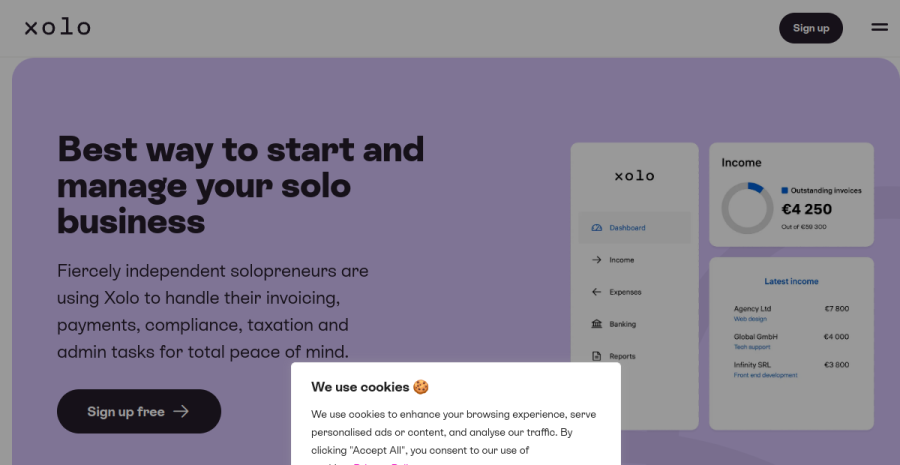
If you want an EU company but not the bookkeeping that comes with it, this is the closest thing to “done for you.” Built around the Estonian OÜ and e-Residency, it bundles formation, monthly bookkeeping, VAT handling and an actual accountant into one subscription — so the recurring cost (the part that actually decides whether incorporating pays off) is handled.
Where it shines. A location-independent EU service solo who bills clients across borders and does not want to learn reverse-charge VAT or hire a bookkeeper. You get an EU legal entity, the OÜ admin and the filings in one place.
The EU angle. Estonia taxes distributed profit, so money you reinvest is not taxed at the company level until you take it out — useful for a solo reinvesting into growth. It is not a loophole: you still owe tax where you are resident, and that needs advice.
Pros: one login for company + bookkeeping + accountant; built for e-Residency; removes the “do I owe VAT here?” question. Cons: monthly cost above a bare formation; oriented around the Estonian OÜ specifically.
3. Firstbase — a US LLC for non-resident founders
Firstbase
If your customers and payment rails are mostly American, a US LLC can be the cleaner base — and Firstbase forms one for non-residents, then handles the ongoing compliance (registered agent, filings, reminders). It is popular with nomadic founders who need Stripe and a US business presence without living there.
Best for: location-independent solos selling primarily to US customers, or who need US payment infrastructure. Cons: a US entity adds US compliance, and you still owe tax where you are resident — a US LLC is a base, not a tax escape.
4. doola — US LLC with the books and taxes bundled
doola
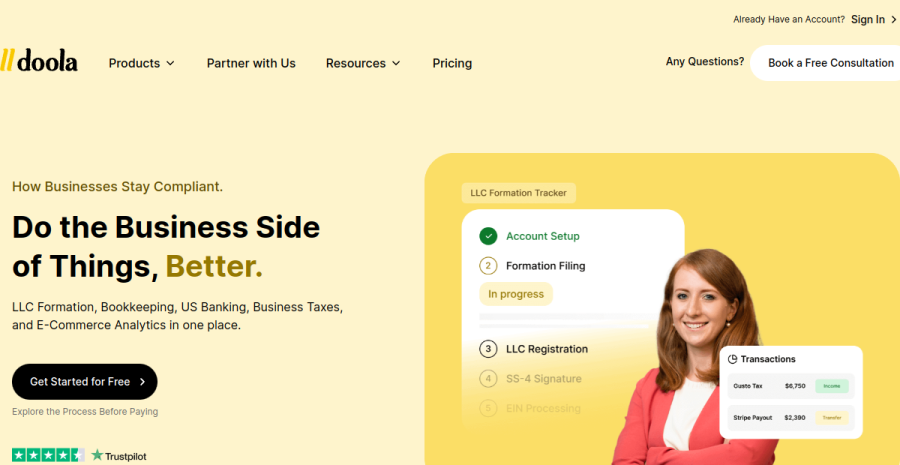
doola covers the same US-LLC-for-non-residents need but leans further into the back office: formation plus bookkeeping and business taxes in one place. For a solo who wants the US entity and does not want to assemble accounting separately, the bundle is the draw.
Best for: nomads who want a US LLC with compliance, books and tax handled together rather than stitched from separate tools. Cons: same point as Firstbase — a US LLC suits US-facing businesses; it is not automatically right just because it is popular online.
How to choose
| If you are… | Pick |
|---|---|
| Just starting, modest income, low risk | Sole trader (for now) |
| An EU solo who wants an EU company, hates admin | Xolo |
| Location-independent, selling mainly to the US | Firstbase (or doola for bundled books) |
| Unsure whether you even need a company yet | Read sole trader vs OÜ first |
The cost that actually decides it
The formation fee is the small, one-off number everyone compares. The number that actually matters is the recurring one: bookkeeping, VAT/OSS filing, and (for an OÜ) monthly accounting. A bare US LLC is cheap to form but you still have to handle compliance; a bundled EU service costs more per month but replaces a bookkeeper. Compare running costs, not formation headlines — the same lesson as the mathematics of a solo business: count the cost of owning the structure, not just creating it.
Bottom line
Pick the smallest structure that fits where the business genuinely is. Stay a sole trader while you are small. Choose Xolo when you want an EU company without becoming your own bookkeeper. Choose a US LLC via Firstbase or doola when your customers and payment rails are American. And whichever you pick, get advice on where you are taxed — that question outranks the entity every time.
Next steps: the structure decision in depth is sole trader vs OÜ vs freelance, the e-Residency route is in is e-Residency worth it in 2026, and the full setup sequence is in how to start and run a one-person business in Europe. Once the company exists, the monthly admin is in the invoicing & accounting roundup.
Before choosing a provider, check whether you should incorporate at all — when should a freelancer incorporate.
Frequently asked questions
Do I need to form a company as a solopreneur, or can I stay self-employed?
What is the best company structure for a location-independent freelancer?
How much does it cost to form and run a one-person company in the EU?
Is an Estonian OÜ through e-Residency worth it for a solopreneur?
Keep reading
Estonian e-Residency & OÜ costs in 2026: what you actually pay
A plain breakdown of the real cost categories behind an Estonian e-Residency company in 2026 — the small one-off state fees versus the monthly accounting that actually dominates your budget. Verify the current numbers on the official pages.

The best Xolo alternatives for solopreneurs (2026)
Xolo is the default for a borderless EU solo — but not for everyone. The best Xolo alternatives compared: 1Office, Companio, pure company formation, local sole-trader setups and US LLCs — by what you actually need.
How to start a business in the EU as a solopreneur: the e-Residency route (2026)
Run an EU company location-independently via Estonian e-Residency — the honest, step-by-step route through structure, tax, VAT, banking and accounting, with the one caveat (it is not tax residency) nobody should skip.
Everything here is free. If something saved you time, you can support the author — no product, no signup.