Best accounting software for Spanish autónomos (2026)
The best accounting software for an autónomo in Spain — Quipu, Holded, Declarando and Contasimple compared. Built for freelancers, with trimestral IVA and IRPF handling, gestoría integration and an honest look at English support.

Solo operator · one-person venture studio in Europe (SEO · affiliate · micro-SaaS) · 12 June 2026 · updated 12 June 2026 · 11 min read

If you are an autónomo in Spain — whether you just got your alta in the RETA, are a freelance designer in Barcelona, or a consultant juggling clients across Madrid — the accounting tool you pick is not a cosmetic choice. It decides whether your trimestral tax filing (the modelo 303 for IVA and modelo 130 for IRPF) takes ten minutes or a panicked Sunday evening, whether your gastos are captured cleanly enough to actually deduct them, and whether your gestoría can pick up your books without re-keying everything. Spanish tax admin runs on a relentless quarterly clock; the right software absorbs most of that pain for the price of a couple of menús del día a month.
How I evaluated these. I judged each tool on what actually matters to a solo self-employed person in Spain, not a US-centric feature checklist:
- Trimestral IVA + IRPF models — does it compute and pre-fill the modelo 303 (IVA) and modelo 130 (IRPF, for those on estimación directa) automatically from your invoices and gastos, plus the annual modelo 390 / modelo 100 summaries?
- Verifactu / e-invoicing readiness — Spain’s Ley Antifraude and the Verifactu / SIF requirements push autónomos and businesses toward certified, tamper-evident invoicing software, with B2B e-invoicing (Crea y Crece) phasing in. Does the tool commit to compliant invoicing?
- Gestoría integration — can your gestor access the account or receive clean exports, so the handover of your returns is smooth rather than a re-typing exercise?
- AEAT alignment — does the output map to what the Agencia Tributaria actually expects, so filing is a confirmation rather than a translation?
- English support — can an expat autónomo run it, or understand help, in English?
Tax figures, models and thresholds below are approximate 2026 public numbers — always verify current rates and the Verifactu timeline with the vendor, the AEAT, or your gestoría before you rely on them.
At a glance
| Tool | Best for | IVA (303) | IRPF (130) | Gestoría access | Verifactu-ready | From |
|---|---|---|---|---|---|---|
| Quipu | Autónomo invoicing + taxes, mobile-first | ✅ | ✅ | ✅ exports + access | ✅ committed | ~€10–25/mo |
| Holded | Fuller ERP/accounting, scales up | ✅ | ✅ | ✅ accountant access | ✅ committed | ~€10–30/mo |
| Declarando | Tax-savings focus + adviser | ✅ | ✅ | ✅ adviser bundled | ✅ committed | ~€25–40/mo |
| Contasimple | Cheap, simple invoicing | ✅ | ✅ | ⚠️ exports | ✅ committed | ~€0–15/mo |
1. Quipu — the mobile-first autónomo favourite
Quipu
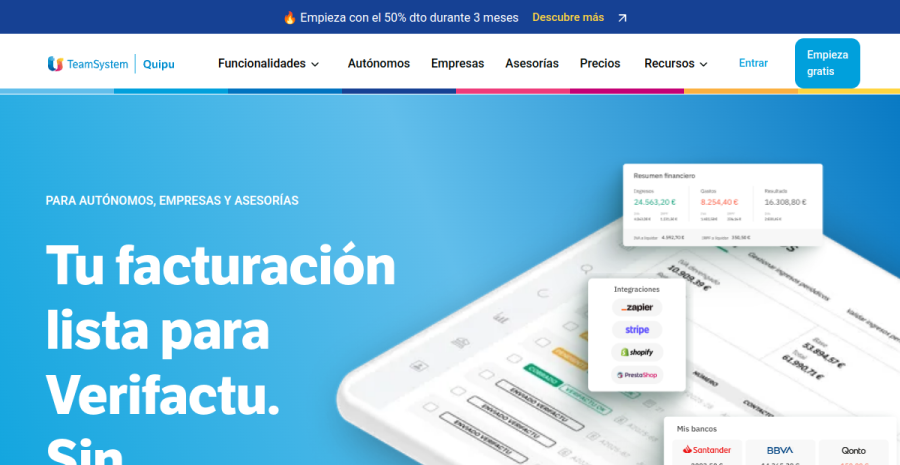
Quipu is the tool I reach for first when an autónomo wants one app that does everything a one-person business actually needs — issue invoices, capture gastos, reconcile the bank, and prepare the quarterly taxes — without the bloat of a full ERP. It is built around the freelancer workflow and is genuinely mobile-first: you can photograph a receipt, issue an invoice and check where you stand on this trimester’s IVA from your phone between client meetings.
Strong on the trimestral tax calendar. From your invoices and registered expenses, Quipu prepares the modelo 303 (IVA) and modelo 130 (IRPF on account), plus the annual modelo 390 and modelo 100 summaries, so the AEAT deadline becomes a review-and-confirm step rather than a transcription marathon. Receipt OCR reads the amount, date and IVA off a photographed factura and files it against the right category — which is the difference between deducting a gasto and losing it.
Built for compliance. Quipu issues structured, compliant invoices and has committed to the Verifactu / Ley Antifraude requirements, so you are not painting yourself into a corner as the mandate tightens. Your gestor can be given access or clean exports.
Worked example. A Barcelona freelance designer on estimación directa sends ~10 invoices a month and photographs every gasto. Quipu books them, prepares the trimestral 303 and 130, and has the annual summaries ready — the gestor logs in to file. Cost: roughly €15–25/month on a mid tier — verify the current plan.
Pros: cleanest freelancer-focused experience; excellent mobile app and receipt OCR; clear trimestral 303/130 preparation; gestor access; Verifactu-committed. Cons: as a focused freelancer tool it is lighter on deep accounting / inventory than a full ERP — if you sell products or expect to hire, you may outgrow it. English coverage exists but is less complete than the Spanish UI — verify before relying on it.
2. Holded — the fuller ERP that scales up
Holded

Holded is the option for the autónomo who can already see past the one-person stage. It is a full cloud ERP — accounting and invoicing, yes, but also CRM, inventory, projects and team features — so it does the autónomo essentials and gives you somewhere to grow without migrating tools later.
The Spanish tax essentials are all there. Holded prepares the modelo 303 and modelo 130, the annual 390 and 100, handles IVA correctly across rate types, and produces proper double-entry accounting (contabilidad) underneath — useful the moment your situation gets more complex than a simple freelancer’s. It is committed to Verifactu / compliant invoicing.
Why “scales up” matters. If you expect to incorporate as an SL, hire, or start selling products, Holded means you are not re-platforming when that happens. The CRM and project modules let you run sales and delivery from the same system that does your books — one source of truth instead of three apps.
Worked example. A Valencia consultant who is an autónomo today but plans to form an SL and add a contractor next year uses Holded so the accounting, invoicing and client pipeline live in one place. Cost: roughly €15–30/month depending on tier and modules — verify current pricing.
Pros: broadest feature set; real double-entry accounting; CRM/inventory/projects for growth; accountant access; Verifactu-committed; strong if you will scale past solo. Cons: heavier than a pure autónomo needs on day one — more to learn, and you pay for breadth you may not use yet; the freelancer-specific flow is less hand-held than Quipu’s. Confirm which tier includes the tax-model preparation you need.
3. Declarando — tax-savings focus with an adviser
Declarando
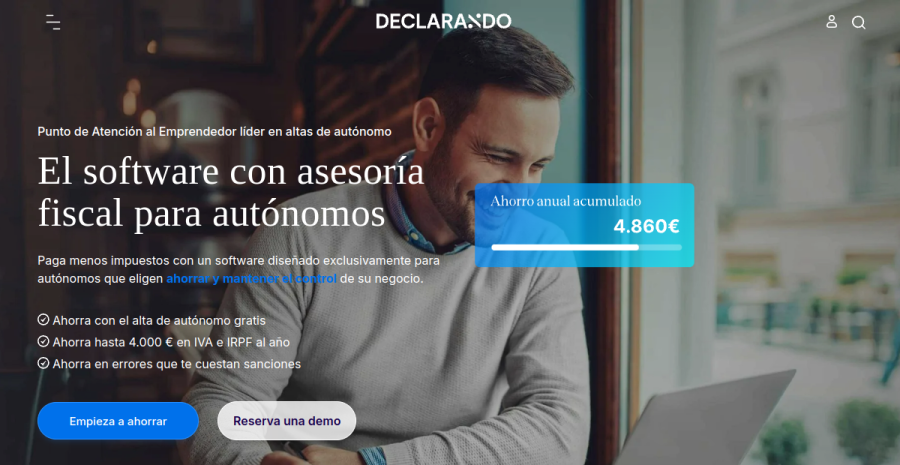
Declarando takes a different angle: it is software plus a tax adviser, built around the premise that most autónomos overpay because they miss deductible gastos and never optimise their situation. Where Quipu and Holded hand you tools, Declarando leans on guidance — flagging deductions you are entitled to and pairing the app with adviser support.
It still does the mechanics. Declarando prepares the modelo 303 (IVA) and modelo 130 (IRPF) and the annual summaries, tracks income and gastos, and keeps you aligned with the AEAT calendar. But the pitch is the savings layer on top: a one-person business that does not have a gestor, or that suspects it is leaving deductions on the table, gets a product that actively pushes back on overpaying.
Adviser as part of the product. For an autónomo who would otherwise pay a gestoría for ad-hoc questions, bundling the adviser can be the whole value — you ask “is this deductible?” and get a real answer instead of guessing.
Worked example. A Sevilla autónomo with irregular income and a pile of un-categorised gastos uses Declarando specifically to capture deductions they were missing and to have someone confirm the trimestral filing is right. The higher subscription is offset against the tax they stop overpaying. Cost: roughly €25–40/month — verify current plans and what adviser access is included.
Pros: strong deduction-finding and tax-saving focus; adviser bundled; good for autónomos without a gestor; keeps you compliant with the trimestral models. Cons: more expensive than the pure-software options; the value depends on how much you were overpaying, which not everyone is; lighter as a general-purpose accounting/ERP tool than Holded. Verify exactly what adviser support each tier includes.
4. Contasimple — cheap, simple invoicing
Contasimple

Contasimple is the minimum viable option — a low-cost, no-frills Spanish invoicing and accounting app for the autónomo whose needs are genuinely simple. Where Holded gives you everything, Contasimple gives you the essentials: issue invoices, log gastos, and produce the tax models, at a price (with a free tier) that is hard to argue with.
Cheap and Spanish-compliant. It generates the modelo 303 and modelo 130 and the annual summaries, handles IVA, and issues compliant invoices with a stated commitment to Verifactu — so a light-volume autónomo gets the trimestral job done without paying for breadth they will never touch.
Where to be careful. As the budget pick, it is less polished and less hand-held than Quipu, its English support is limited, and gestoría integration leans on exports rather than rich access. For a simple freelancer that is fine; if your situation is more involved, or you want the smoothest gestor handover, the pricier tools earn their cost. Verify exactly what it submits versus what it prepares for you before a deadline.
Pros: lowest cost, with a free tier; covers the core invoicing and trimestral models; simple enough to learn in an afternoon; good fit for low-volume autónomos. Cons: less polished and feature-light versus the others; limited English; gestoría handover is export-based rather than integrated; thinner support. Confirm it covers your exact filing needs.
Worked example: a Barcelona autónomo, three paths
Take a Barcelona autónomo on estimación directa billing around €40,000/year — charging the standard 21% IVA, filing the trimestral modelo 303 and modelo 130, and the annual 390 / 100. What does each path cost in money and effort?
| Path | Rough yearly cost | What you get | Trade-off |
|---|---|---|---|
| Quipu (basic) solo | ~€180–300 | Invoicing, gasto OCR, trimestral 303/130 prepared, gestor access | You do the day-to-day; you (or a gestor) file |
| Holded | ~€180–360 | Same plus full accounting, CRM, room to scale to an SL | Heavier than you need today; more to learn |
| A gestoría | ~€600–1,200+ | Someone else does the books and files everything | 3–5× the software cost; you still feed them data |
The honest read at €40k: a Quipu-basic-solo setup (~€180–300/year) covers the mechanics well, and many autónomos at this level run Quipu themselves and only pay a gestor for the annual income declaration (the renta) or for occasional advice — not full-service bookkeeping. Holded costs about the same but buys you headroom to grow; a gestoría costs several times more but removes the work entirely. Most one-person businesses land on software for the quarters, gestor for the year. These figures are approximate; gestoría fees vary widely by region and complexity — verify.
How to choose
| If you are… | Start with |
|---|---|
| An autónomo who wants the cleanest, mobile-first freelancer tool | Quipu |
| Planning to scale, hire, sell products, or form an SL | Holded (ERP with room to grow) |
| Worried you overpay tax and want an adviser built in | Declarando |
| On a tight budget with simple, low-volume invoicing | Contasimple |
| Unsure | Run the free trials of Quipu and Holded for a week — solo-focus vs scale-up will decide it |
The blunt summary: Quipu for most autónomos, especially solo freelancers who want the simplest path through the trimestral calendar; Holded when you can see past one person; Declarando when advice and deductions matter more than features; Contasimple when price is the deciding factor. All four offer a free trial or free tier, so test before you commit a cent.
ES footnote: what Spanish autónomo accounting actually requires
Every tool here is built for the Spanish regime — but the obligations are yours, not the software’s. Practical checklist:
- Trimestral models — on estimación directa you file the modelo 303 (IVA) and modelo 130 (IRPF payments on account) every quarter, plus the annual modelo 390 (IVA summary) and your income in the modelo 100 (renta). All four tools prepare these; verify which they submit versus prepare.
- IVA correctly applied — the standard rate is 21% with reduced rates for some activities, and some autónomos (or operations) are IVA-exempt. The tool must apply the right rate and the recargo de equivalencia where relevant. Confirm your rate — getting it wrong cascades into every return.
- Verifactu / Ley Antifraude — Spain is moving to certified, tamper-evident invoicing software (Verifactu / SIF), with B2B e-invoicing under Crea y Crece phasing in. Use a tool that commits to compliant invoicing and verify the current timeline — dates have shifted.
- Keep your facturas — Spanish rules require you to retain issued and received invoices for years. Cloud tools help, but the legal duty to retain is yours.
- Gestoría or not — even with software, many autónomos keep a gestor for the annual renta and advice. Ask which tool your gestor uses before you choose, so the handover is clean.
None of this is legal or tax advice. Models, rates, thresholds and the Verifactu timeline change — confirm the current rules with the vendor, the AEAT, or your gestoría before filing.
Stop letting bookkeeping eat your evenings
Spanish admin doesn’t get simpler — but the right tool turns your IVA/IRPF filings and invoicing into a few clicks instead of a lost evening. Most autónomos start with Quipu:
Cross-links: new to all of this? Start with becoming autónomo in Spain for the alta, RETA and tax basics. For the broader tool comparison across the EU, see the pan-EU accounting & bookkeeping roundup and the invoicing & accounting roundup. And for the full picture of the admin, tax and tooling around going solo here, see the hub on running a one-person business in Spain.
What the certified-billing rule actually requires, and the new 2027 deadline: VeriFactu for autónomos explained.
Frequently asked questions
What is the best accounting software for autónomos in Spain?
Quipu vs Holded — which is better?
Is there software that handles IVA and IRPF models for autónomos?
Does it integrate with a gestoría?
Keep reading
Best business bank account for Spanish autónomos (2026)
Which bank account a Spanish autónomo (self-employed freelancer) should open — Wise, Qonto, Revolut and N26 compared for low-FX international income, IVA/IRPF handling, cuota de autónomo direct debits and English support, honestly and EU-aware.
Running a one-person business in Spain (2026): the complete toolkit
How to run a freelance business in Spain as a solo operator — the complete toolkit of tools and software for autónomos in Spain, from alta de autónomo and banking to accounting, e-invoicing (Verifactu), hosting and insurance.

Best accounting software for Italian freelancers & partita IVA (2026): Fiscozen vs Fatture in Cloud
The best accounting software for Italian freelancers — Fiscozen, Fatture in Cloud, Aruba and Qonto compared. Regime forfettario-friendly, FatturaPA/SdI-ready e-invoicing, and an honest look at which tools work in English for expats.
Everything here is free. If something saved you time, you can support the author — no product, no signup.