Hostinger review (2026): the honest take from a site that runs on it
A first-hand Hostinger review for solopreneurs — real pricing, EU data centres, speed, the Node.js upgrade path, and who should pick something else. Written on the host it reviews.

Solo operator · one-person venture studio in Europe (SEO · affiliate · micro-SaaS) · 12 June 2026 · updated 12 June 2026 · 3 min read

Most hosting reviews are written by people who have never run the host they rank #1. So let me be blunt: you are reading this on Hostinger. That is the whole reason this review is worth your time — it is not a spec sheet rephrased, it is the honest account of a host I actually pay for and deploy to.
Affiliate disclosure: the Hostinger links here are affiliate links. I recommend it because I use it for this site — not the other way round.
Hostinger
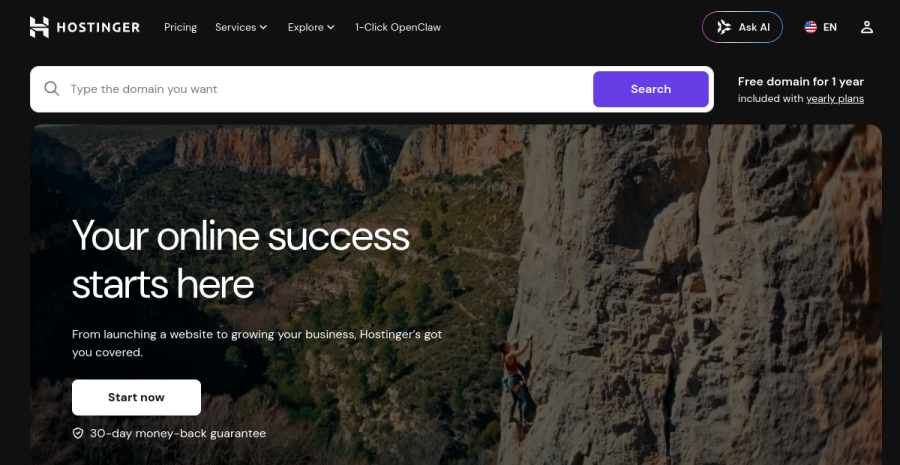
EU-founded budget-to-mid host (Lithuania) with EU data centres and a clear upgrade path from a static site to managed Node.js. The pragmatic default for a pre-revenue European solo — and the host this magazine runs on.
What it is, and who it’s for
Hostinger is a budget-to-mid web host, EU-founded (Kaunas, Lithuania, 2004), offering shared hosting, managed WordPress, and increasingly managed Node.js application hosting. Its sweet spot is the price-sensitive solopreneur who wants a fast, EU-hosted site without paying premium-managed prices before there is any revenue to justify them.
If that is you — a one-person business launching a marketing site, an affiliate/content site, a WordPress site, or a static site like this one — it fits cleanly.
What’s genuinely good
- Price at the entry point. The shared plans are about as cheap as credible hosting gets. For the pre-revenue phase, that is exactly right — you should not be paying premium hosting to validate an idea.
- EU data centres. Vilnius and Amsterdam mean a reader in Berlin gets their first byte fast, and your GDPR story is simpler. For a European audience this is a free Core Web Vitals win.
- A real upgrade path. The Business tier adds daily backups, a free CDN and more resources; the managed Node.js tier (GitHub/ZIP/IDE deploys, one predictable price) means you do not have to migrate hosts the day you add a backend. This site is static-first (Astro SSG) with a one-step SSR migration planned for exactly that tier — which is precisely why I chose it.
- It is genuinely fast on a static setup. Pre-rendered HTML + the bundled CDN is the cheapest way to be fast, on any plan.
What to go in with your eyes open about
An honest review names the catches:
- Renewal pricing. The headline price is the long-term rate; renewals are higher. Check the renewal cost before you commit, not after.
- It is not white-glove managed WordPress. If you run a revenue-critical WordPress site at serious traffic and want expert WordPress support and staging, that is a different (pricier) category — Kinsta or WP Engine territory.
- Upsells in the dashboard. Like most budget hosts, you will see add-on prompts. Easy to ignore, but they are there.
Where it isn’t the answer
- Revenue-critical WordPress at scale / agencies → managed WordPress specialists (Kinsta, WP Engine).
- Pure JAMstack hobby projects → an edge platform’s free tier (Vercel/Netlify/Cloudflare Pages) may be a better fit.
- You need a data centre in one specific EU country Hostinger doesn’t operate in → check the current list first.
The verdict
For the European solopreneur who wants one host to start cheap and grow into — without a painful migration the moment they add a backend — Hostinger is the pragmatic default. I would know: I pay for it, and you are reading this on it. Just go in aware of the renewal pricing, and upgrade tiers only as the site earns them.
Start with HostingerThis is the single-product take — the full field, including the premium and edge alternatives, is in the web hosting for solopreneurs in Europe roundup. Building the site that goes on it? See my weekend launch stack.
Frequently asked questions
Is Hostinger good for a solopreneur in 2026?
How much does Hostinger actually cost?
Where are Hostinger's data centres, and does it matter for GDPR?
What are the best Hostinger alternatives?
Keep reading
Best web hosting for solopreneurs in Europe (2026)
What actually matters when a solopreneur picks a host — speed, EU data location (a GDPR-friendly European alternative to US hosts), and room to grow into Node.js — plus the one I run this magazine on.
How I disputed a hosting provider's billing in 30 minutes with AI (a documented 2026 EU case)
A real, documented case: a Finnish host auto-charged against its own invoices and sent penalty reminders before the due date. How I used AI to research it across two languages and get every charge cancelled — in about half an hour.
Brevo review (2026): the email tool I actually run across my projects
An honest, first-hand Brevo review for solopreneurs — why I use it across multiple projects, the pay-by-emails-sent model, EU data residency, where deliverability genuinely wins, and the real catch with its automation and send limits.
Everything here is free. If something saved you time, you can support the author — no product, no signup.